

It’s a blue-skied, early-autumn day and I’m tromping a creek-side trail deep in western North Carolina’s Pisgah National Forest. For years, I’ve been drawn to these treed slopes and tumbling streams. Today, though, I’m neither fishing, nor backpacking, nor hunting mushrooms — my usual excuses for wandering the woods. Instead, I’ve come to check on a hard-working family of “ecosystem engineers” that moved to the neighborhood a decade ago.
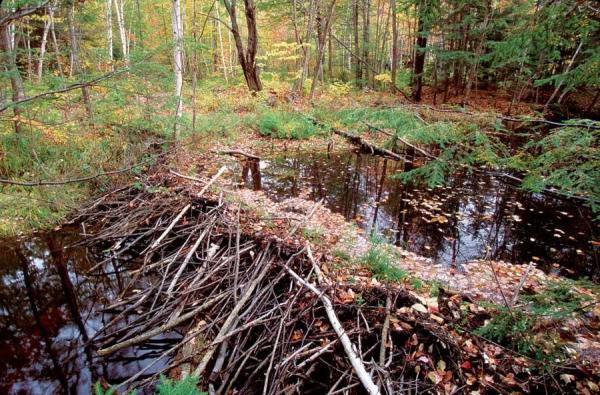
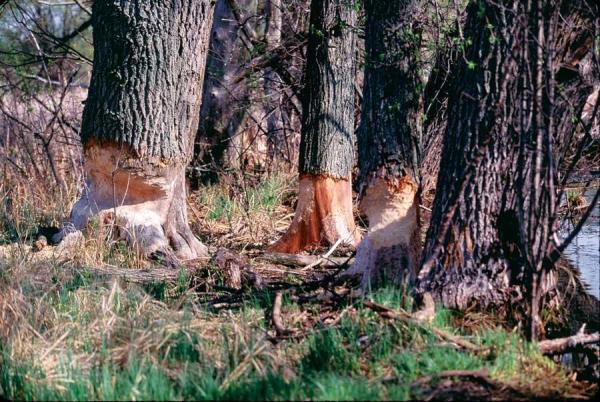
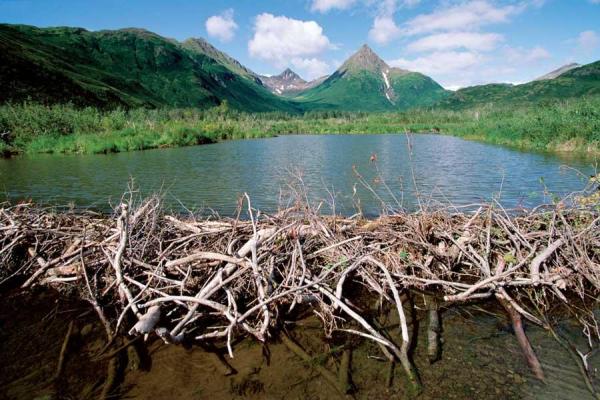
I round a bend, and a downed tree blocks the trail, its gnawed end and pencil- stubbed stump telling me I’m nearing my destination. I step over it and proceed past more tooth-whittled trees. As I top a rise, the woods open and the landscape transforms. Before me lies a still pond of some 5 acres, with a broad margin of grassy marshland. A few yards from the high bank where I’m standing, a jumble of logs, sticks and mud blocks the creek, slowing the flow to a relative dribble of its upstream rush and tumble. This is the beavers’ dam, built to provide deep, still water for a safe home. I don’t see the rounded dome of a stick-built lodge. These busy beavers, like many another, instead may have burrowed into a bank underwater, then up, to hollow out a subterranean home. Tall, dead trees rise from the pond that slowly killed them, their bleached trunks pocked with cavities drilled by woodpeckers, but now used by birds and other creatures for shelter.
I move to a log and sit down in the sun. Tap-tap-tap. A downy woodpecker shinnies up one of the old trees, mining for insects. A breeze stirs the marsh grass. Dragonflies flash at the water’s edge. Ahhh. I’ve come here for this — not expecting to see beavers, which are mostly nocturnal, but to soak in the results of their work. A beaver pond is an extraordinary place, peaceful during the day and a center of activity at night.
It’s also the perfect place to consider the beaver itself — an animal regarded by some as a pest and by others as an environmental savior. For centuries the beaver has shaped not only our landscapes, but also our history and our attitudes towards wildlife.
Just a Humble Rodent
Wildlife biologists came up with the “ecosystem engineer” classification for beavers: a species able to alter its environment to suit its needs. In that capacity, beavers are perhaps second only to humans. But unlike humans, beavers are driven not so much by intent as by instinct. It’s the sound of running water, for example, that stimulates a beaver to build or repair a dam. And their legendary ability to fell trees in a particular direction? Not so. A beaver simply gnaws until the tree falls — sometimes on the beaver.
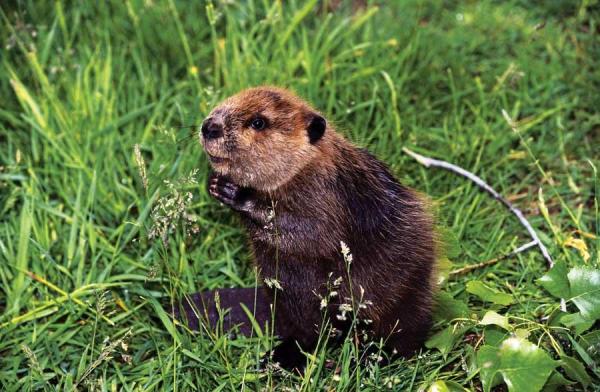
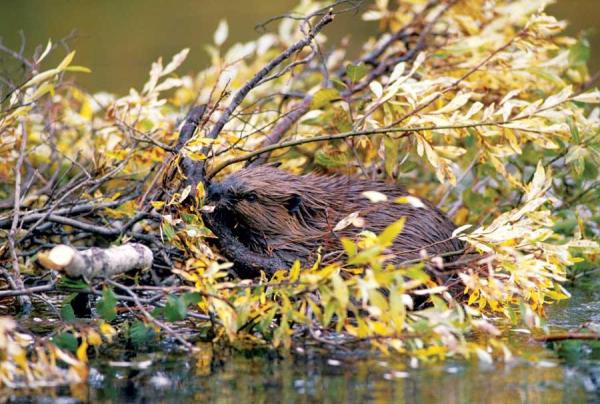
A busy beaver is just a humble rodent going about its biological business — for which it’s extraordinarily well-equipped. It’s the beaver’s bulk, for instance, that helps it bulldoze mud, rocks, and logs into place. Only one other rodent in the world — South America’s capybara — is larger. An adult beaver weighs between 40 and 60 pounds. A rare few have approached 100 pounds.
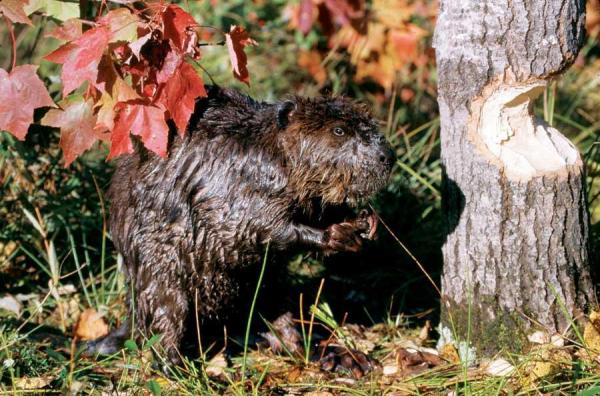
From tail to nose, a beaver measures about 4 feet long. Its powerful jaws and strong teeth resemble the jaws of a logging grapple, with four long, and curved, front incisors for cutting, 16 flat back teeth for chewing, and an arched space between for gripping limbs. The outer surfaces of its incisors are clad in hard enamel. The incisors’ softer inner layer wears away more quickly, so the teeth are perpetually honed to a chiseled edge.
A beaver can snip a limb from a shrub with a single bite. To fell a tree, the rodent stands upright while using its flat tail as a prop. It turns its head sideways, cuts and tears off a chunk with its incisors — and so on, and on, until its woody prey topples. Beavers favor trees between 4 to 8 inches in diameter, but they’ll tackle bigger specimens — the largest recorded in North America was nearly 4 feet across.
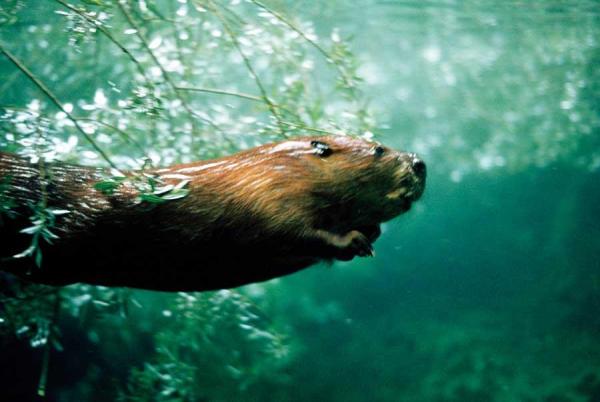
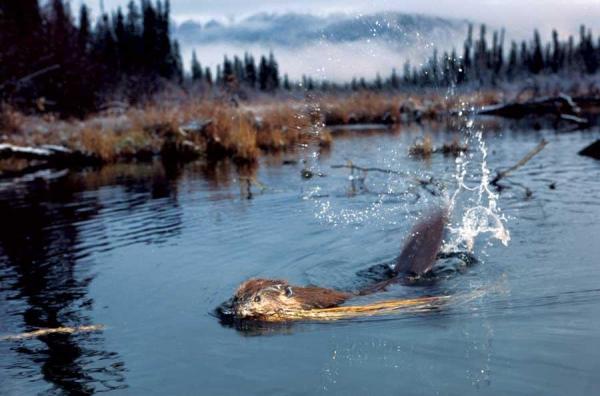
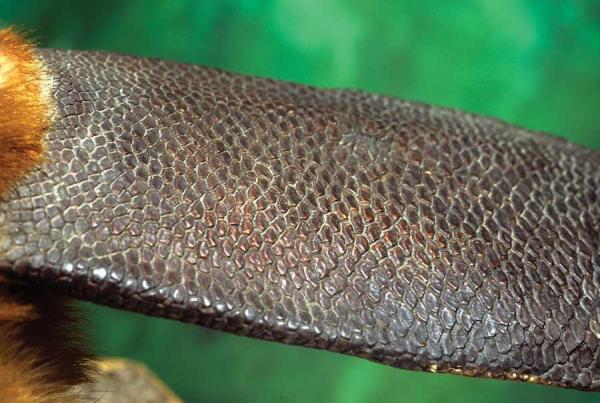
Despite its terrestrial logging skills, a beaver moves awkwardly on land — an almost-fish-out-of-water — and thus is susceptible to predators. Adapted for an aquatic existence, beavers spend 80 percent of their lives in water. Large, webbed hind feet propel it through water easily, even while holding sticks to its chest with its five-fingered forepaws. Its tail — typically about 6 inches wide and twice as long — serves as a rudder. A beaver can stay submerged for about 15 minutes, though one or two minutes is more usual. When a beaver dives, valves close over its ears and nostrils, and a transparent eyelid covers each eye.
Topping off the beaver’s extraordinary aquatic anatomy is a double layer of fur that keeps the animal dry and warm. The outer layer consists of long, glossy, darkbrown guard hairs that the animal waterproofs by rubbing with an oil from its anal glands. The shorter, lead-gray inner fur is soft and fuzzy. It’s this insulating underfur that enables a beaver to withstand subzero temperatures and ice-cold water. Unfortunately, it’s also the stuff that got the species into near-to-extinction hot water in centuries past.
To the Brink of Extinction
When Europeans began exploring what’s now the United States and Canada, they found beavers in boggling profusion. The precolonial population was at least 65 million — some say 300 million or more.
In Europe, felt hats made from the underfur of New World beavers became a fashion rage that lasted from the 1600s until the late 19th century. Enormous quantities of pelts were exported. Between 1853 and 1877 alone, the Hudson’s Bay Co. sold 3 million pelts.
As their numbers dwindled in the East, beavers became the carrot on the stick that lured explorers westward into unknown territories, opening lands for settlers. Beavers disappeared throughout most of their range by 1900.
But today the species is again thriving throughout most of its historic range. The tide turned in the 1920s, when modern wildlife management practices, protective laws, and stocking programs helped reestablish beavers. The beaver’s reproductive proficiency contributed, too.
Dam Sweet Home
Building a dam is a beaver couple’s first step in starting a family. In a pinch, they’ll make do almost anywhere there’s water and wood, but they prefer a site with relatively flat land upstream of water flowing between raised banks.
Working together, the animals cut limbs and brush, and drag or float them to the site. First they lay a foundation of branches positioned with the butt ends facing downstream to catch debris. Then they dredge mud and rocks from the stream bed and push those materials onto the limbs to anchor them. Next, the beavers lay logs and sticks across the foundation, building higher and wider. They pack a plaster of mud and debris into the spaces between larger materials, giving the dam’s upstream side an especially heavy coating.
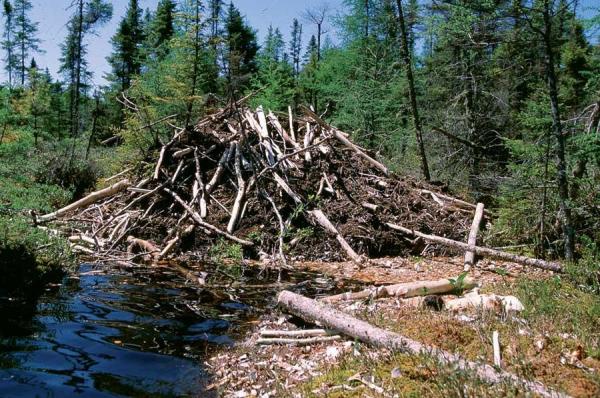
With their dam built to an acceptable height and a pond filling in behind it, the beavers turn their attention to constructing a lodge. Some burrow into a bank. But most heap together a dome-shaped, mud-glued pile of limbs that extends from the pond’s bottom to several feet above the surface. Then, starting underwater, they tunnel upward through the pile and excavate a dry, roomy chamber several inches above water. Final touches include one or more additional underwater entrance/exit tunnels. The result is a shelter nearly impervious to predators, with multiple escape hatches should an enemy break through.
Each year beavers instinctively add materials to their dam and lodge, regardless of whether additions are needed. A typical lodge extends 3 to 6 feet above water, but old lodges towering 15 feet have been recorded. Likewise, dams from 10 to 100 feet wide are common, but some grow larger. A dam found in Montana measured 2,296 feet wide.
Busy Beaver Families
Beavers live in colonies, each consisting of one family in a single lodge. The male and female breed in winter. Three and a half months later, three to six fully furred, foot-long-or-so kits are born. Within days they’re swimming, clambering onto their mother’s back when tired. Both parents care for the babies, which are notably vocal, crying for their mother’s milk, cooing if pleased.
Beavers, including adults, are communicative and social. Family members frequently groom one another. Parents and kits play in the water, circling and rubbing noses. Even the beaver’s famous tail slap, used to warn other beavers and frighten predators, carries social nuances. Members of a family can tell by sound who’s slapping, and respond accordingly. If it’s the mother, the entire colony instantly dives. A father’s slap is less authoritative. If it’s a kit, nobody pays attention.
After several months, young beavers can forage on their own, but nonetheless stay near their parents. The next spring, they help care for the new litter and pitch in with construction chores. The following year, however, as another new litter arrives, the 2-year-olds leave the colony to seek their own territories, find mates and start new colonies.
The Many Benefits of Beavers’ Work
The annual exodus of ready-to-reproduce 2-year-olds from existing colonies into new territories, plus each female’s potential to produce 30 to 40 young over an average 10-year lifespan, has helped the beaver spring back from the brink of extinction — but that also is what pushes beavers into conflicts with humans. In problem areas, beavers can destroy crops, flood fields and highways, and kill landscape plantings.
Then again, the positive impact of beaver activities can be enormous. By creating wetlands to suit their aquatic habits, beavers transform woodlands into diverse habitats that support a greater diversity of animals than before. Aquatic plants flourish. Insects abound, providing sustaining protein for birds. Frogs, salamanders, and small fish at the water’s edge draw herons, kingfishers, raccoons, and other carnivores. Larger mammals, such as fox and deer, also thrive.
A beaver pond and its marsh store and filter water, slowing runoff from storms, allowing heavier silt and pollutants to settle. Water downstream is clearer and cleaner, its flow more stable and less prone to drought and flooding.
Even after beavers abandon a dam, allowing the pond to drain and leaving only broad mud flats, their impact persists. Vegetation springs up rapidly in the rich accumulated sediment. The result is a beaver meadow, itself a wildlife magnet.
Back at the Pond
I’m sitting on my log, soaking in the solitude, when a mountain biker stops to chat. When I comment on the beaver pond’s peaceful beauty, he grimaces and remarks that beavers may be OK in their place, but where he lives, they’re pests. “We can’t get rid of them,” he says, and then rides off.
Alone again, I consider the beavers, the dam, the pond, the encompassing forest — and us. A century ago, there were few trees remaining on these slopes. The region’s hills had been denuded, not by beavers — we’d wiped them out by over trapping — but by human loggers. And the only dams in the area were human-made splash dams.
At least we humans have learned some lessons since then. We manage our forests better, for the most part; though, we could still do better with disappearing wetlands. And the beaver’s near-miss with extinction, plus the loss of too many less fortunate species, has brought home the importance of tempering our actions with concern for other creatures.
Maybe it’s time to work on another lesson: how to live as peaceably as possible with a fellow ecosystem engineer — one that, in many ways, has a better record than ours. Welcome back, beaver. Here’s to our future.
Beaver Control
In many areas, homeowner/beaver conflicts are increasing. To a beaver, water trickling through a road culvert is just another brook to dam and landscape trees are as munchable as wild trees. You can’t blame a beaver for being a beaver — but what can you do?contr
Peaceful Coexistence. Protect trees by wrapping them in hardware cloth. Plant conifers, which beavers dislike, rather than deciduous species. If flooding is a problem, install a “beaver baffler” — a drainpipe assembly placed to lower a pond’s level. That will prevent the beavers from detecting and damming the flow.
Beaver Removal. Unfortunately, live-trapping and releasing a beaver in a different place usually dooms it to a slow death. In some states it’s also illegal, as may be destroying a beaver dam or lodge. Check with your state’s wildlife agency for regulations and assistance with beaver control.
Beaver Information Resources
Beavers: Wetlands and Wildlife
Nuisance Beaver Control Techniques Manual
Beaver Management in North Carolina





