
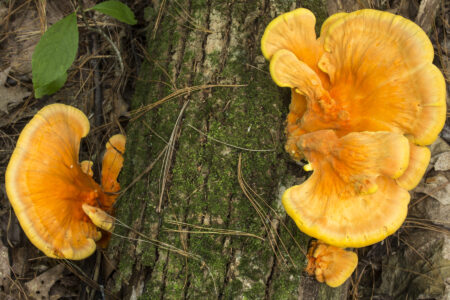
It’s easy to master chicken of the woods identification, so learn where to find chicken of the woods and start foraging mushrooms now!
Chicken of the Woods/Sulphur Shelf
Laetiporus sulphureus
This is the gateway mushroom for many novice foragers. As an edible mushroom, bright yellow-orange and often growing halfway up a tree, it is easy to spot and hard to mistake for anything else. It is also one of the tastiest edible wild mushrooms when in good condition.
Where to Find Chicken of the Woods
Although there are several shelf mushrooms foragers call “chicken,” including a mostly white one(white chicken?), Laetiporus sulphureus is the easiest to spot. It grows on oak and occasionally other hardwood trees in eastern North America, primarily in summer and autumn, but occasionally in spring or winter as well.
There are other similar looking and also edible Laetiporus mushrooms that grow in other parts of North America. The host trees vary from species to species. For instance, L. gilbertsonii is a West Coast species that grows on eucalyptus as well as oak. Understanding wood species can help identify the correct foraging spots and avoid bad spots where toxins may be absorbed.
Chicken of the woods mushrooms only grow on wood, and that is part of their identification. But I have seen chicken mushrooms that looked like they were growing on a lawn because there was a log buried just beneath the surface.
Chicken of the Woods Identification
Laetiporus sulphureus fruiting bodies can grow nearly 2 feet across and are usually many individual caps arranged in a shelf-like or rosette formation. These caps are up to an inch thick and have yellow pores on their undersides (there are no gills). The upper surface is bright orange or yellow in young specimens, fading with maturity and exposure to direct light. This bright color is one of the key visual cues. It has a suede-like texture.
There are no stems on chicken of the woods mushrooms. If you break one of the caps open, the flesh is white to pale yellow, moist in young chickens, becoming crumbly with age. Fresh mushrooms are best for eating, especially when they still have a tender mushroom/chicken texture and moist interior. Collected specimens will maintain flavor and texture for a couple of days if stored properly.
What to Avoid When Identifying Chicken of the Woods
- Avoid mushrooms on toxic trees: Don’t harvest from yew, eucalyptus, or coniferous trees, which may transmit toxins to the mushroom.
- Watch for look-alikes: Jack-O’-Lantern mushrooms resemble Chicken of the Woods but are toxic and glow faintly in the dark. Like mentioned earlier, avoid anything with stems, and anything that grows on the ground.
- Never eat raw: Always cook thoroughly to avoid stomach upset or nausea. Rinse gently in cold water before cooking to remove debris.
- Avoid older specimens: Aged or woody mushrooms can be indigestible and unpalatable. Choose young, vibrant clusters. Inspect for insects or contamination and clean well before cooking.
- Test for sensitivity: Some people are allergic or intolerant. Try a small portion first. Rare reactions have been reported when consuming alcoholic drinks.
- When in doubt, don’t consume: If you’re unsure about the ID, throw it out. Better safe than sick.
Sustainably Harvested Mushrooms
Although many mushrooms have essential, symbiotic relationships with trees, chicken of the woods is a parasitic mushroom that can eventually kill its host tree. You are not endangering the fungus by harvesting its fruiting bodies (the part that we eat). By the time you spot a chicken of the woods mushroom, its mycelium has already done irreparable damage to the tree. It can often be found on the stumps and logs of trees, as well.
Harvest by slicing off the mushrooms near the base. It’s best to harvest them when they are young and tender, but there are uses even for the older, drier ones (see below).
Preparing Chicken of the Woods
Prime chicken of the woods mushrooms are young enough that their flesh is still moist and has a spongy but firm feel. They are absolutely delicious sautéed, fried, or simmered in stews. (Note that all wild mushrooms should be cooked.) Chicken of the woods is a fantastic alternative for recipes that traditionally use chicken meat, offering a meatless substitute for chicken in vegan dishes.
Older chicken of the woods mushrooms are often unnecessarily passed up by foragers. It’s true that their chalky texture never becomes tender and moist, no matter how much liquid is in your recipe or how long you cook them. But once dehydrated and ground in an electric grinder, you’ve got a powder packed full of fantastic mushroom flavor that is excellent added to risotto and other dishes. This technique extends their usefulness over a longer period of time, beyond their initial shelf life.
To try one of those dishes yourself, see this recipe for Chicken of the Woods Pasta Sauce Recipe.
More from The Forager’s Feast:
• Foraging Wild Henbit
• Henbit Noodles with Mushroom Sauce Recipe
• Foraging Morel Mushrooms
• Stuffed Morel Mushrooms Recipe

Reprinted with permission from The Forager’s Feast: How to Identify, Gather, and Prepare Wild Edibles by Leda Meredith, published by The Countryman Press, a division of W.W. Norton & Company, 2016.





