

Why are sea turtles endangered? Discover the human impact on North American turtles and learn about the steps we can take to help.
When I was young, my mother taught me the creation story of our ancestors. She explained that when the Creator made what we now call North America, it all started with a giant turtle. Upon the back of the turtle was placed soil so all beings – plant and animal – could live together. Collectively, Native Americans often call this land Turtle Island. She explained how the turtle’s shell has 13 segments and how they correspond to the 13 lunar phases of the moon. She told me that when we feel earthquakes, it’s just the turtle moving. The turtle is slow-moving, slow-reacting, and, sadly, slow-healing, just like the Earth itself.
At the Turtle Rescue League, located in Southbridge, Massachusetts, Michaela works on a painted turtle (Chrysemys picta) that recently came in with severe injuries after being run over by a car. While it’s better now, Michaela admits that she didn’t know if she was going to be able to save it. But the little turtle had a couple of things going for it: It had been rescued by a Wampanoag woman from Mashpee who drove the two hours to the League to save it, and she had given the turtle a sacred medicine bundle.
My friend and fellow writer Sy Montgomery introduced me to the people at Turtle Rescue League, but she couldn’t fully prepare me for what I’d see and feel. After seeing what I saw, I felt great sorrow and anger. I explained my feelings to Natasha, the director at the Turtle Rescue League. She said, “I know how you feel, but who will you lash out at? It’s better to turn your energy to saving those you can.” I walked outside to collect my thoughts, burned sage and tobacco, and prayed for the injured turtles and the people trying hard to save them.
Humans have a direct and negative effect on our turtle populations. Turtle poaching and habitat destruction, ranging from deforestation to polluting our waters, is taking its toll. Then, there’s human-induced climate chaos. The oceans are warming and the marshes are drying. We’re destroying where the turtles live.
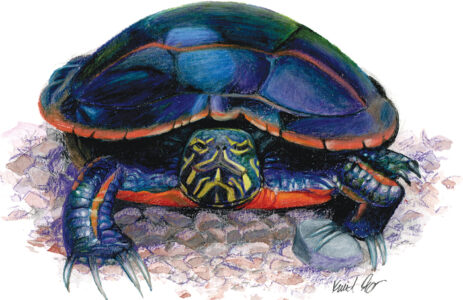
Like many children of the 1960s and 1970s, I had a pet turtle. It lived in a cheap, hard plastic dish complete with a plastic palm tree. One end of the dish was deeper than the other to hold water for the turtle. We fed the turtle “turtle food,” pieces of lettuce and bits of raw hamburger. We thought we were treating the turtle well. Little did we know that we were actually slowly killing this beautiful animal.
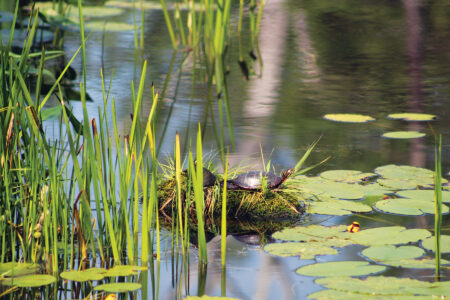
As I grew older, my attention was drawn to the ocean, and sea turtles became my focus. This is funny because sea turtles very rarely venture farther north than Cape Cod, Massachusetts, but sea turtles were my “thing,” so I learned as much as I could about them. What I failed to see was that the woods, fields, and ponds near my home were full of turtles. Painted, wood, spotted, box, and Blanding’s turtles could be found all around me, and common snapping turtles ruled the murky depths of the marshes.
Endangered Turtles
Whether intentional or not, humans are impacting an animal that’s lived on this planet for 300 million years. Turtles survived the mighty dinosaurs and mass extinction, but will they survive us?
Of all the creatures on Earth, humans are the most destructive. We tend to destroy all that’s around us to suit our short-term needs. We don’t seem to give any forethought to the long-term effects of our actions.
Turtles On Land
That fancy golf course down the road is a prime example. Those lush greens destroyed valuable natural habitat for a great deal of wildlife, including the box turtle. According to Natasha, each box turtle has a very small habitat range (about 250 yards on average). Once that habitat is gone, even if a turtle is saved, it often can’t be released, as turtles are genetically programmed to their one specific area.
Let’s move to those golfing greens. How do they keep them so neat and green, even during a drought? They use (literally) tons of chemical-based fertilizers and herbicides and a massive amount of water. Have you ever noticed that even during a drought, when families are rationing water, farmers’ fields are drying out, and forest fires are springing up everywhere, the golf courses are lush? That water is coming from the ponds and streams that turtles and other wildlife depend on.
Excess fertilizer and herbicides run into that cute stream or pond on the golf course, as well as into groundwater. Once there, they poison all life in those environments. Plant, animal, or human, the poison doesn’t care.
Unlike amphibians, reptiles – including turtles – lay their eggs on dry land. Even sea turtles come ashore to lay their eggs. So, now that the golf course has destroyed the turtle’s living space and polluted the water, next are the breeding areas. That natural field that surrounds the new golf course is turned into a parking area. Turtles used that field to lay their eggs. Now the destruction is complete. In a very short time, for the sake of hitting a little white ball, we’ve completely destroyed an entire ecosystem and all the living beings in it, including turtles.
Why are Sea Turtles Endangered?
The ocean is a magnificent place, and one we know the least about. It’s home to some of the world’s most graceful creatures, including turtles. Sadly, many of these creatures are endangered because of human activity.
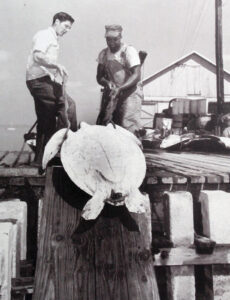
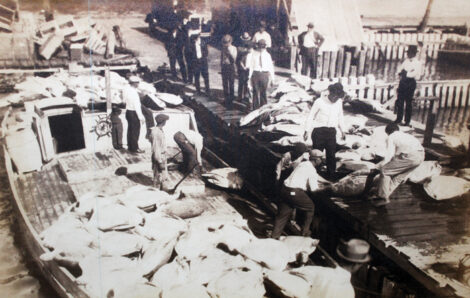
Starting in the 1800s, Key West, Florida, was the hub of the turtle hunting industry in the United States. Turtles were slaughtered by the thousands to make turtle soup and canned turtle meat. Their shells were made into combs, jewelry, and other trinkets to be sold on the piers. A popular spot today in Key West is the turtle kraals, which were the holding pens where captured turtles were held awaiting their fate.
It wasn’t just full-grown turtles that suffered. The eggs of these animals were dug out of nesting sites and collected and sold for human food. Because of overharvesting and the destruction of nesting areas, sea turtle populations in Florida and the Caribbean dropped to near extinction. It wasn’t until 1969 that the U.S. enacted the Endangered Species Conservation Act. While this helped, it didn’t stop the hunting. In 1973, the Endangered Species Act was signed, protecting the sea turtles. Hunting was stopped.
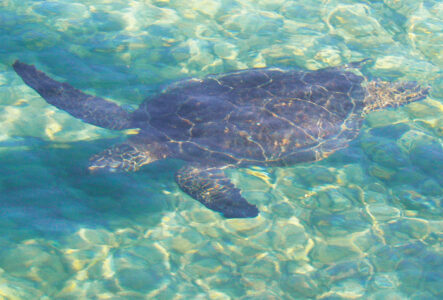
Sea turtles still face other hurdles just as dangerous as hunting. Pollution is a major concern. Discarded plastic is often eaten by turtles, as it resembles jellyfish. Even small pieces of plastic and cigarette butts, which can be confused with shrimp, are often eaten.
Because of the warming oceans, sea turtles often find themselves in unfamiliar waters. The water off the New England coast is becoming warmer, and the turtles are making their way farther north than normal. The problem is that these waters don’t stay warm, and the turtles find themselves caught in water too cold to sustain them. In her book Of Time and Turtles, Sy Montgomery speaks about spending time with other rescuers, in the middle of an extremely cold winter night, rescuing sea turtles caught in these deadly conditions. This type of thing is happening along all of our coasts, and it’s the result of our actions.
Turtles In the Desert
My next stop after the Turtle Rescue League was the hot and dry Sonoran Desert of southern Arizona. My goal was to find out about the elusive and threatened Sonoran Desert tortoise. Unlike their turtle cousins, tortoises are entirely land-based. They’re also vegetarians. The Sonoran Desert tortoise (Gopherus morafkai) is uniquely adapted to this environment, spending a great deal of time in deep burrows that protect it from the scorching sun. Despite my desperate search, I never found a tortoise in the wild. I decided to head to the Arizona-Sonora Desert Museum to find out more about these elusive animals.
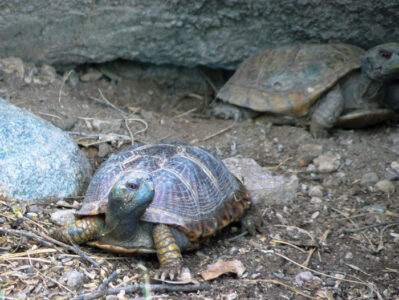
I learned that tortoise numbers are decreasing, and because of this, the Sonoran Desert tortoise is listed as threatened and protected under Arizona law. Like all laws, this one is good only if it’s enforced. According to the people at the museum, the major threat to these animals comes from habitat destruction caused by human development, human harassment, poaching, and climate change. Their environment is also threatened by invasive plants that crowd out the native vegetation the tortoise feeds on. Notice a common theme here: Humans cause the tortoises’ issues.
Human Cruelty
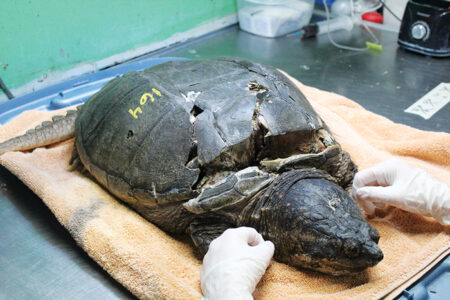
Back in New England, at the Turtle Rescue League, Michaela is working on a rather large snapping turtle that’s in rough shape. This turtle was hit by a boat. The severely injured turtle had pulled itself up on shore, where it slowly began to die. While plenty of people saw the turtle, nobody did anything; that’s until the maggot- and infection-filled turtle became a “nuisance,” as the smell of its rotting flesh ruined their outdoor gatherings.
Natasha then showed me photos of another snapping turtle. This one had about a half-dozen 3-inch framing nails shot into it by someone with a nail gun. What’s wrong with people? Do some people have such low self-esteem that they feel the need to hurt other creatures that can’t defend themselves?
The good news is that both snapping turtles are making a recovery, although healing is a slow process for turtles.
Can We Change?
Researching turtles opened my eyes in many ways. I’ve seen the worst and the best in people. I’ve seen the impact that we humans have on our environment. We need to seriously think about what we’re doing. Is another golf course or shopping mall worth it? Do we need that super-green, chemical-enriched lawn? Can we change our behavior? I hope so – for our own sakes and for the turtles.
Support Turtles with these Resources
- Help the Turtle Rescue League.
- Learn more about tortoises.
- Visit Sy Montgomery’s website.
Dana Benner has been writing about all aspects of the outdoors, the environment, and self-sustainability for 35 years. His work appears in Countryside & Small Stock Journal, Grit, Mother Earth News, and others.
Originally published in the August/September 2025 issue of MOTHER EARTH NEWS and regularly vetted for accuracy.





