
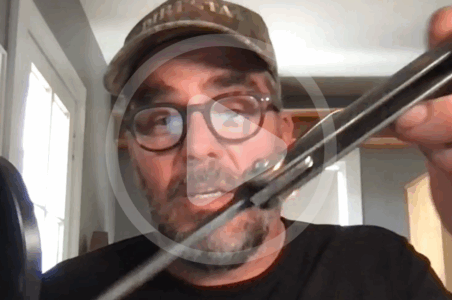
Jimmy DiResta: When I taught for 24 years, my big thing for all them was just experiment. Don’t go into this thinking you’re gonna make it perfect just be welcome to the fact you’re gonna screw up. You might actually invent something new that nobody’s ever done in this process ’cause you don’t know how to do it. So I teach them, go into it with an open mind. Really look for the breakthroughs. Right now the breakthrough is you’re just trying to get it. Experiment with that. The big fear is and it’s funny because, and I use this as an example all the time, people watch somebody in sports or they’ll watch somebody play a violin and they’re like, wow. Years of practice, years of dedication. And they watch me do a perfectly bound book in a two hour demo. And then they go home and they go, there’s no way I could do that. I can’t do it as perfect as you. I’m like, you’re not expected to do it as perfect as me.
Josh Wilder: Welcome to the Mother Earth News and Friends podcast. At Mother Earth News for 50 years and counting, we’ve been dedicated to conserving the planet’s natural resources while helping you conserve your financial [00:01:00] resources. In this podcast, we host conversations with experts in the fields of sustainability, homesteading, natural health, and more to share all about how you can live well wherever you are in a way that values both people and our Mother Earth.
My name is Josh Wilder and I’m the Content Director here with Mother Earth News. I’m here with Jimmy DiResta. He is a maker and artist you might know from his popular YouTube channel, co-host of Making It podcast, co-author of Workshop Mastery, host of Making Fun on Netflix, and half a dozen other shows that have showed his skills.
He works with wood, metal, letter press, recycled materials, making furniture, sculptures, and just about any other project in his mind.
Jimmy DiResta: I wanna meet that guy.
Josh Wilder: And Jordan, an artist and designer who, teaches in the fine art department at Pitt Community College.
Thanks for being here. Like I said in my email when I reached out, I turned on your show for my son and he’s just, he’s obsessed. I wake up early on Saturday and just turn it on by [00:02:00] himself. I gotta get his question out of the way first.
Jimmy DiResta: Sure. Let’s do it.
Improving Your Workshop
Josh Wilder: Is the ultimate workshop real?
Jimmy DiResta: Yeah, I’ve achieved it. I personally have achieved it. It’s a long-term goal. Every workshop that I’ve had– which now has been, I can’t count really, but probably at least seven different, eight different workshops — has been the best workshop at the time until I decide I need to learn something new add a discipline to the shop, and then I upgrade the space. And it really is true, like they say about animals. Like a snake, for instance, will live within its confines. It won’t grow anymore. And every time I’ve gotten a shop and expanded my square footage, I’ve grown.
In my creativity, I’ve grown in my collecting of course, and my ability to have bigger, more interesting, fun vintage machines. So I just keep adding space to my life, which as long as I could afford it, I’m okay. I think I’m gonna take a pause for a minute, but I do wanna maybe build a giant industrial building on one of my properties, but I won’t do that.
I’m [00:03:00] gonna enlist the partner. I’m gonna split the, it’s a conversation right now we’ll, see where it goes.
Projects Around DiResta’s Property
Josh Wilder: For sure. Yeah. And you’ve been at that property where the workshop is now for what, I think I heard 20 years.
Jimmy DiResta: 20 years. Yeah. September was my 20th year of closing on this property.
When I bought this in 2004, I bought the house. It’s an old farmhouse with a lot of rooms. It was a boarding house. It’s got 11 bedrooms, 11 full-time bedrooms. And if I needed to add this room I’m in with a bed and the living room, that adds two more. So that would be 13 bedrooms if I needed. And this weekend we just did maker camp, so everything was full, every room in the house was full with friends.
But I bought the original house with the multiple bedrooms on 17 acres. And I went on the tax map and I saw the property next to me, had nothing built on it, but I saw who owned it and I wrote them a letter in 2004. And then in 2006 they reached out to me and we made a fast deal. I refinanced and included that in my property.
And so I got that. So now I have 40 acres. That’s 23 acres. The house originally is 17, but if you go back in time, this house was [00:04:00] the center of hundreds of acres. This was the original house for, this is one of the oldest houses in several mile radius, and most of the property belonged to this original homeowner in 17, originally built in 1790.
In that. I quickly went to a new family. I actually know the history. I gotta brush up on my details, but the same family owned it for generations. So they owned all the farmland.
Josh Wilder: That’s awesome. And then you have the graveyard house you’re working on too, right?
Jimmy DiResta: That’s, yeah, down the block. That’s an old it’s a four bedroom house.
A four bedroom farmhouse. I bought it gutted from the previous short-term owner. He bought it in the beginning of the pandemic. Dug into it, gutted it, cut down every living tree that was on the property, which was probably about a hundred trees. So now the house sits alone on a big, empty field.
Headstrong into the winds. My neighbor has 180 acres, and I’m three of those acres in that little development, and it’s, it just 180 open [00:05:00] field acres. It’s beautiful space there. If you’ve seen some of the videos. So I’m a little island cut out of my neighbor’s, 180 acres, and he said I love that you’ve restored this house.
He’s really happy with that. And right across the road is also part of that parcel. That’s another 10 acres. So all in it’s about 13 acres with a big barn. So that’s a project. So I’m digging into that house. The biggest part of this last year was spent fixing the foundation.
Josh Wilder: Cool. Yeah, I saw the video on that.
Building with Confidence
Josh Wilder: And that kind of brings us into kind of our, the big theme I kinda wanna go into a little bit. Yeah. For this talk is kinda really just building with confidence. Like whether it’s a DIY project, whether it’s restoration, whether it’s maintenance, really just like going into a project and you’ve worked with kids and like knowing what it takes to get them actually not only interested, but like feeling like they can do something.
Jimmy DiResta: Yeah. Yeah.
Josh Wilder: So like, how, how do you approach?
Jimmy DiResta: When I taught at the School of Visual Arts for 24 years and my big push to teach the kids intimidating things. [00:06:00] They’re all graphic designers that for the most part of those 24 years we’re using computers and developing graphics flat on a page. And I was like, this is how you do 3D. This is how you might take sculpty clay and you bake it in the oven. You have a 3D object and you take that object, you make it latex mold or a silicone mold and you make a generation and then you do package construction design.
And my big thing for all them was just experiment. Don’t go into this thinking you’re gonna make it perfect just be welcome to the fact you’re gonna screw up. You might actually invent something new that nobody’s ever done in this process ’cause you don’t know how to do it. So I teach them, go into it with an open mind. Really look for the breakthroughs. Right now the breakthrough is you’re just trying to get it. Experiment with that. The big fear is and it’s funny because, and I use this as an example all the time, people watch somebody in sports or they’ll watch somebody play a violin and they’re like, wow. Years of practice, years of dedication. And they watch me do a perfectly bound book in a two hour demo. And then they go home and they go, there’s no way I could do that. [00:07:00] I can’t do it as perfect as you. I’m like, you’re not expected to do it as perfect as me.
Just get your hands on the materials, experiment, start to understand how the glue works, how it dries, how the paper folds, hit the cracks, when it cracks, how to make the Roman corners around the folded edge of the book binding cover. You gotta figure all that out. So this is just throw away the first five and then you start to really look at it and think, okay, my learning is really starting to really take hold.
So that’s really what I do. And especially with kids. I’m like, let’s just experiment. Let’s have fun. Don’t think you’re gonna do anything that I’ve done in my portfolio straight away. I’ve been at it since I’ve been at it for 40 years, 50 years. I’m 57. I started in my workshop five or six years old with my dad.
So the practical way to hold and use a screwdriver and expect it to slip and poke me in the hand. I learned all that at six, seven years old. Those are skills that if you never used it, you gotta go through it. You gotta go through it.
Josh Wilder: Jordan and I both have young kids. How late were you at Scouts last night, Jordan?
Jordan Krutsch: Oh, golly. I left there around 8:45 [00:08:00] to kicking and screaming ’cause he had to go home and do homework.
Josh Wilder: Yeah, exactly. So we’re trying to figure out that now as dads, but it’s the same thing when you’re working with people and trying to build a project together.
Something you said on your podcast, I heard you say is what’s the best that could happen?
Jimmy DiResta: Yeah. What if everything works out?
Josh Wilder: Yeah.
Jimmy DiResta: Because, my dad was a little bit, my dad really I owe everything I’m doing to my dad, but my dad had, he’s from a different generation where there was always that hovering of fear. It was always that what if it doesn’t work out? He said, I go, dad, I’m going to art school.
Maybe you should also take the police exam. Maybe you could be a police officer in case that doesn’t work out. And I might have said to him 35, 40 years ago, I might have said, what if it does work out? Yeah, let’s be positive. What if it does work out? What if everything goes right?
What if everything goes right because you talk to anybody, you say, I’m gonna take this tractor and carry that pallet and I’m gonna hang it on the top of that truck. And then from there I’m gonna do a rope. And they go, what if it doesn’t work out? I’ll figure it out right there and then, and I’ll make it work out.
Make it go right. That’s another phrase. A [00:09:00] friend of mine taught me early on, one of my early mentors, she would always say, make it go right. I’m like, I don’t know what I’m doing. She just goes, make it go right? You got the skills, make it go right.
Josh Wilder: I like that. Yeah. And I feel like the, what you were talking about with the graphic designers, and that speaks to me ’cause I got my BFA in graphic design.
Jimmy DiResta: Yeah, me too.
Josh Wilder: That’s great, yeah. That’s where I’m approaching like, Mother Earth News from and content creation in general is just, taking everything and making it easily digestible as possible. So once you’re past that kind of curiosity stage of like. What if everything goes right?
Building as Artistry
Josh Wilder: Then you get into your creative space. How do we do this? We are all artists, but I had a hard time calling myself an artist.
Jimmy DiResta: Sure. I did a podcast once and the subject was. Are you an artist? And I basically said, you have the permission to call yourself an artist.
And it was so touching a young man who was, who took a class here. I knew him. His name escapes me at the moment, but he wrote me the longest letter. He said, when you said that he’s an ambulance driver, he says, when you said that, I pulled over to the side of the road and I broke down in tears. He said, because [00:10:00] I’ve been resisting that for years.
My father never wanted me to be an artist. My mother thought it was a loser path. And when you said it’s okay to call yourself an artist, and I was just freestyling, I wasn’t trying to make any profound statements, but when he called me and told me that, and then eventually I overheard it at a couple of meetups, like when you said it, it’s okay to call yourself an artist.
It really hit home for me ’cause people resist it because it’s like the Scarlet Letter in a lot of families.
They want you to get a real job, join the family business of construction or whatever it is.
Josh Wilder: Yeah, but there’s so much artistry in reclaiming old doors or, any kind of carpentry really.
Any kind of making, there’s artistry in that.
Jimmy DiResta: Yeah, I always say make something every day, even a sandwich, putting together a sandwich. Every decision is a creative one. Every decision you make is a creative one. Whether you drop that piece of salami on it and you’re like, should I fold it?
If I fold it, I have to put another one next to it. And if I, and if you’re OCD, you’re gonna put three in a row. ’cause you want it to look good as if there’s a magazine camera over your shoulder. Every decision you make is a creative one. Whether it’s [00:11:00] gonna be a fine art piece that hangs in a gallery, or whether you’re just deciding how to arrange your shoes across the edge of the mudroom.
Every decision you make is a creative one.
Everything Gets Used Eventually
Josh Wilder: Yeah, you talked about having a lot of storage and I saw when you were making a table out of a door, like your kind of door collection. I have a hard time getting rid of stuff.
Jimmy DiResta: Me too.
Josh Wilder: Especially for our Mother Earth News audience, it’s about waste reduction. It’s about doing as much as possible with as little as you have. At what point do you decide okay, I’m gonna do something with this?
Jimmy DiResta: I will, when people say, I’m gonna keep this in if I haven’t used it in a year, I use things that I’ve had sitting around for seven, eight years.
So it is a very difficult decision for me to look at something and go, I haven’t used it in a year. It’s also currency. If it’s good fodder, it’s currency that you could trade to a friend, or if it’s a good machine. A lot of times people drop off machines. To me, I’ll never use them, but I have a good currency in that machine.
When somebody comes along and they’re like, I’m needing this old lathe. I’m like, that one right there? I’m like, if you like [00:12:00] that’s yours. I can have that. Really? Aren’t you gonna use it? I go, I never used it once. Someone brought it here. And I couldn’t say no. I’m almost like like the way I always joke about instead of fostering puppies, I foster old machines because I can’t see them sit outside and get rusty.
I say, bring them inside. Come on. We’ll bring ’em inside. We’ll take care of them. Some of them make it inside, not everyone. But the good thing about old steel is that it’s always revivable. So everything gets used eventually. I really do believe that. But within reason. For instance, my we’re clearing out, my dad passed away and we’re clearing at his house, and he had piles and piles of cutoffs.
And wood. And wood. And I would always say, and I even said it in my most recent episode of The House Build, I keep all my materials at the lumberyard. I let the lumber yard be my storage unit. ’cause when I go and get it, it’s not grade from weather, it’s straight, it’s not rotten because it’s been standing in a puddle for a year.
When I’m ready to use it and it’s exactly the length I need, I don’t have to cut off two inches, all that type of stuff. And that’s primarily coming from my dad. So I’m very selective and I curate the junk that [00:13:00] sits around me. I’m not taking pallets simply because they’re there. I know where they are.
If I need ’em, I go and get ’em. I always get my fresh lumber when I get it. And a lot of times when you see somebody cutting down a tree and I’m like, Ugh, there’ll be another tree. I’ll get it eventually. When I’m ready to look for a tree and I know it’s gonna go right on the new sawmill, or if I’m gonna be able to make a hammer stump or something or other it’ll be there.
So I’m not that much of a hoarder. I’m very selective in my hoard.
Reducing Waste During Builds
Josh Wilder: So on the top of that, I’ve noticed you also kinda use the whole hog or try to make sure that you’re not wasting much while you are in the project. Like I think I saw you put an arch out of a board and make sure that you were you were taking the cut that you took and adding it to the top, for instance.
Jimmy DiResta: Oh yeah. I’ve done that. That’s a technique I’ve I learned a long time ago. Yeah. If you cut like a four by four, you can make it like a, like maybe a six or eight inch curve by. Cutting out the scallop out of the flat side and then gluing it right on top flat. That’s an old technique I used to play with on the bend.
Josh Wilder: So are there any other techniques like that where you think you’re stretching materials, [00:14:00] making sure,
Jimmy DiResta: Yeah, for instance I have a new horse barn in the back and I made all the doors. 9 doors.
Two of those nine doors are actual double doors, big double doors. So 13 doors, door frames. And I bought a bunch of three inch by three inch, quarter inch thick angle iron. And I got down to it and I realized, oh, I don’t have enough to finish the big door. And I was like, wait a minute. I got scraps laying all around me and I just tacked together, bunch of scraps.
Nobody would know where the seam is. So I just tacked together. And it’s funny, a lot of guys, I talk to welders, old school welders. And they say, I realized early on if I make a mistake in welding and metal, I could just weld another piece on and hide it and versus woodworking where you have to get more creative.
If you’re gonna cut something short, you have to just start over or come up with a creative scarf joint, and in some cases you can’t really put a seam in a timber or something or other, whatever. But, so a lot of guys say, I checked out woodworking when I was in school and I checked out metalworking, metalworking.
You can make mistakes and hide ’em much easier than wood, but [00:15:00] in general all. I always say, what’s, I’ve learned this from a lot of people. What is a professional in woodworking? A professional metalworker, it’s just getting better and better at hiding your mistakes and making it look intentional. So with metal, you could always scab it back together.
And with wood, if you have bits and pieces of wood and you gotta scab something together like the magician say, turn that into your feature. And look, I made this outta 17 pieces of wood when it really should have been made outta one. But I had 17 pieces of scrap. Nice. My boat, I recently made, I made a rowboat a year ago, and the rowboat is made out of all the leftover porch planks from my front porch of my home.
I redid my front porch and I was ripping up all these doug fir porch planks that were put on a hundred years ago from a tree that was probably harvested in a few years before that, but started growing a hundred years or maybe 400 years before that. Who knows, because the grain lines are so tight in a, in an inch there’s 70, 80 grain lines, and that’s 70, 80 years worth of growth.
And I was like, I cannot burn this. I was about to just go throw it in the [00:16:00] fire and I put a fresh cut on one end to see what’s inside of it. ’cause it’s all covered with lead paint and the ends are all rotted on both edges. And I was like, whoa, there’s some beautiful stuff hidden in here. So I saved it all.
I still have a giant pile on my front porch pins, but I made a boat out of it. I made a few little end tables out of it and I’m gonna do another video soon where I take all the,
Jordan Krutsch: I forget with that one, didn’t you, did you do the cove and bead on that for. The joints for the boat.
Jimmy DiResta: I didn’t do a cove and bead on that.
I actually, I made a canoe in 2018 and I did that, came with the cove and bead on it. Okay. This was just, butt joint, but every time you blow up a plank, you take a hand plane or a hand plane that has a whole bleeded blade or think it would be called a, a joint plane, joiner plane. And then go right around and then make that rolling bevel so that the next board you put on it will land right on it.
Yeah, that was a real learning experience. That was fun. And so putting that boat together, all my porch planks were no longer than seven [00:17:00] feet, but the boat is 14 feet, so there’s scarf joints everywhere. But I made that a feature. Wherever the wood was really weathered from the being near the edge of the porch, I actually did my scarf joint close to that.
So when I did my scarf joint, one of them is aged and one of them’s clean. So I accentuated that just to show and I was always looking for the nail holes if I could find them, because you have a beautifully shaped boat, which I didn’t design. My Steve Killen designed a beautiful, classic, beautiful wooden boat.
But when you get up close, you start seeing, oh, there’s a nail hole, but the nail holes filled in the pop and it’s intentional. And the scarf joint looks like bamboo. ’cause this one, there’s a scarf joint here, and one here starts to look like a feature. So that’s why I say you always accentuate instead of trying to hide and be shamed about it, take it and make it a feature.
Projects for a Clean Workshop
Josh Wilder: So kinda talking about that accentuating and that being your, level of, makes you professional and and the horse barn, frankly. I talk a little bit about your clean shop that you’re working on and what all you’re [00:18:00] looking at doing up there. I know you’d mentioned that you made a cover for your sewing machine doing more sewing and kinda leather work up there.
Jimmy DiResta: Yeah, the second floor of the horse barn. Is a clean space for me. It’s a clean space. I don’t have really a clean space. I do now, but when I started my leather, I ran for my leather business a year ago and I came up with a pattern that I really like, and everyone seems to really like it.
I’ve been able to sell quite a few of them and. Every time I got a hide in, I was buying three hides at a time, four hides at a time. I would bring ’em into my living room and lay ’em on the floor because it’s the only place where I know no water’s gonna get on ’em. No animal’s gonna pee on ’em and no saw dust and grinding powder’s gonna burn the edge or get near ’em and I can lay ’em out.
And also, I also, it’s really funny. Everybody worries about my leather. They’re all like, how are you gonna store? Go, just lay it on the floor like, but it’s gonna get in your way. I go, I just won’t stand in that part of the room. It’s gonna be fine. You’re not gonna hang it on a rack or put it on a shelf.
I’m like, no, because when I get leather, I like to immediately unroll it, lay it, lay flat on the floor. [00:19:00] ’cause when you need a piece of leather that you’re not fighting a bump in it, you’re not fighting a scene that’s been created. Or even worse, you’ve rolled it up and now you needed a year later and it just wants to stay in a role.
And you can’t work it on the table or on the sewing machine ’cause it’s rolled up. So that’s why I just leave it laying flat on the floor and now all my hides are up there and I’ve actually, since I’m up there, I’m being productive. I need to buy more hides. I’ve kind, I’ve gone through all the useful stuff already.
I’ve turned them into bags in the last couple, a couple of maybe last week. They’re all I made about 15 bags out of everything that was light in my living room. Wow. Nice.
Josh Wilder: So at what point do you are, do. So having that more space. More space. Is there anything else in that clean shop that you’re looking at that, I know you’ve done some letterpress work, for example,
Jimmy DiResta: Yeah, the letterpress is down the block now. I bought an old racetrack, which is where I do my annual hangout with my friends and fans that want to come and they bring a handmade go-kart and we goof off on the day on the track. And it was an old concession stand where you could [00:20:00] buy hot dogs and ice cream and run on the track.
So the building that’s there has the mechanic’s garage for the go-karts in the back and inside there’s a was what would’ve been the old dining area. If you bought a hotdog, you go sit in the dining area. And now that’s all my print presses are in there now.
Josh Wilder: That’s awesome.
Welding Projects
Josh Wilder: Is that the go-kart you made on Hammered?
Jimmy DiResta: No, the one I made on hammered was a. It was a TV prop that was a prop. Now what I made on hammered was so many years ago. Now I’m like, I’m much more into welding than I was at that point. When I got on YouTube, I stored I’ve welded and I welded on that show, but when I got on YouTube, I got a, I got an endorsement deal with Lincoln Electric primarily because like you’re the average nube that.
Weld occasionally we wanna show the home garage guy that he can get a welder, learn how to weld, and he doesn’t have to be a certified welder to do VBV groove welding on the pipeline. So I’m not intermediary where I’m not a farmer, I’m a furniture [00:21:00] maker. But I could also do this. I could fix a leg on a table or I could fix my trailer.
And so that, that was really the marketing ploy with me behind. So when I really got machines, I started really welding. A lot more often. I went to school at Lincoln a couple times for just some basic skills and then just challenge yourself with projects. The more projects you do, the more you challenge yourself to weld, the better you get at anything.
So I developed a lot of welding projects, and so now the go-karts that I’m making for my Go-Kart event are all welded up. I’ve made three in a row now. The first two years, the first year was COVID, the second year was admitted beginning of that TV show that we talked about. So I, we finished the episode, the final episode, the day before the Go-Kart event.
So I didn’t have a chance to build anything. So the last three years, so we’ve done five and a, but the last three years I’ve built a go-kart every year and I’ll do that every year until the event is done. That’s awesome. Yeah, it’s always fun. So I start thinking now it’s becoming a short tradition, it’s in July, so May, June, I start thinking about what I’m gonna make and [00:22:00] start gathering the materials and go to Harbor Freight by a, by an engine and start thinking it through.
Josh Wilder: Nice.
Projects Around the Farm
Josh Wilder: So talking about, you’re not a farmer, but have a farmhouse and all the land, and I know there’s probably, maintenance projects you have around and having all your skills come in handy.
For somebody who wants to pick up a skill and they have some property, where would you suggest them starting?
Jimmy DiResta: I have chickens. I do take the eggs, so I maintenance the chicken coop and I built a chicken coop, which was really easy to do. That’s a simple thing.
Some four by fours and some what do you call it? Hard cloth wire, which is that tight closed wire you can get at the gardening shop or tractor supply. That that was cool. I’ve gone through lots of birds in the last, almost 10 years now. I have right now I have three turkeys. So the turkeys are fun.
I don’t eat anything as far as meat goes. I just harvest the eggs and they’re more pets. But everybody wants the eggs. People come by all the time. They’re like, do you have any eggs? And then there’s that prime time in the summer where you’re getting like 25 eggs a day and you don’t know what to do with them.
Giving ’em to [00:23:00] everybody that comes by. And yeah. So now I’m getting about one egg a day, maybe, if I’m lucky. ’cause it’s cold out now. But the chicken coop is an easy thing to get into. You could even buy one, but I recommend making one. And you don’t need a lot of space if you have one or two chickens.
And what else I got a big field and it’s fenced in and we had a drought in 22 and my neighbors have five cows. And they were raising him for slaughter and he said, we are running outta grass because nothing’s growing. He said, can we have my cows? So the cows were in my field all of August and a little bit of September, a few years ago, and that was a lot of fun.
So what I’m gonna do, and I just reached, my business partner, reached out to me he’s my partner on the house down the block, which is got that big 10 acre field, and I have at least three acres in the horse pasture. And he’s would you consider renting to a farmer? I said, sure, if we can, if you could find a tenant that wants to grow something, bring it on.
Accessing Reclaimed Materials
Josh Wilder: So having all these projects and, trying to use as many materials as you can [00:24:00] that are, they’re reclaimed. How does someone who may not have as, as much, as many access to the materials you’re using to take off your porch or the door that you might have taken out?
Jimmy DiResta: It sounds crazy, but any construction site dumpsters have the great stuff. I used to be in the city full-time. I’m upstate full-time now, but when I was in the city prior to six or seven years ago, dumpsters were the greatest.
I there was, I remember when I very first started my New York City shop, the one where I started my YouTube channel, but I had to shop for about four years before I started my YouTube channel. All my early videos are down in this basement hole, in the basement of a tenement building. I was dumpster diving constantly.
I had no money. I was living paycheck to paycheck then in Manhattan, which was a rough making a rough go of it. I had a few clients that I knew would always, I was on retainer with a few people designing, developing products and making prototypes and doing interior design a little bit here and there.
But you stop at any construct and people are ripping out plywood that they don’t want anymore ’cause it’s got paint on it. It’s perfect for a workbench, two by fours. Nobody wants to clean [00:25:00] the nails out of ’em. Perfect for workbench legs.
It’s all free material. And then one of the, one of the best fruits of the city was the old tenement buildings.
If you were gonna rehab a three or four story, or six story tenement, there was some rule where you had to get rid of the timbers. The three by 10, three by 12 inch doug fir timbers all have to go right in a dumpster, and they’re 20 feet long. And you could barely pick one up, one end by yourself. They’re the floor joists that go from brick wall to brick wall.
They are the floor joists of all these old 10 buildings built in the 1880s. 1890s. And if you’re gonna rehab one, you gotta replace it with steel. Those buildings were designed so that the brick wall, my dad taught me this ’cause he was a fireman. So when you see these old timbers in the dumpster, the ends are chamfered.
They’re really chamfered like this so that when the fire in the middle burns, if there’s a fire, which they always know there would be eventually the timbers tip out of the wall. They don’t pull the bricks in with ’em. So all these timbers go wall to [00:26:00] wall with the chamfered corners. You could tell it’s a full piece ’cause the, you could still see the end on ’em and then they’re out, like half pieces for stairwells and stuff.
So that. Was a huge giving tree in the city is when they designed when they were going to rehab a six story building. They were gonna be pulling those things out for months. Every floor, front to back, a hundred feet, six floors. If they’re every 18, 20 inches, 20 inches on center, there’s a hundreds of ’em in the building and they just don’t want them.
But there are guys that did come along and reclaim them, and there was a lumberyard in Brooklyn called M Fine Lumber. And they would take those old three bys, four bys, four by twelves, three by nines. They were all different thicknesses. They were basically the I-beams that held up all these floors and all these old tenements and the city is still full of them.
There was the building boom in the 1890s, 1880s, and 1890s. All those buildings that were built then are majority, A lot of them. So there’s always gonna be that wood coming outta them. It’s all old growth, Southern [00:27:00] pine doug, fir insane with beautiful textures on ’em. They have now I have shelves all around the house made out of ’em.
Josh Wilder: That’s great.
Jimmy DiResta: So that was, I would take ’em and cut ’em up into pieces that I haven’t thought about that actually until you just asked me that pointed question. But yeah, I would find that stuff all the time. I remember one Thanksgiving morning. I happened, pawn a dumpster full of them and there was nobody around.
Everybody was getting ready to have dinner with their family and I said, I gotta get out. ’cause tomorrow the city’s gonna be bustling. They’re all gonna be taken by dirt bags like me. So I spent the whole morning of Thanksgiving morning before I drove out to my mother’s house. I kept driving back to my shop, I’m driving to the ninth Street and drive back to my shop and brought ’em back to ninth Street.
I have a pile of them in my backyard. I would always grab ’em when I could. They’re not easy to get, especially in an old Tundra that only has a 66 inch bed. I’d lay ’em up on my roof, so they’d be like, on the tailgate, they’d be on the tailgate and on the roof, and they’d be sticking up past the roof a few feet and sticking back past the tailgate a few feet.[00:28:00]
I can get a 10 foot piece on the truck, crushed my taillight, but on the, the third light on the back of the cab. But who cares? You got free wood.
Josh Wilder: Nice. I’m imagining you, so this is when you were down in your basement doing your first videos, and I saw, I went back and I watched your first video that you still have on like public on YouTube of the foot chair.
Jimmy DiResta: Oh yeah, I made that, yeah, I made that about six or seven years before I started my YouTube channel. Yeah.
Josh Wilder: Yeah. So what would you do with those sorts of projects after you were done with them?
Jimmy DiResta: That sat in the basement for years, and then I brought it up here. When I bought this house. I made that before I bought this house, and then when I bought this house, I brought it upstate and I put it in the woods, and so it was a destination.
You just walk in the woods and then you see this foot sticking outta the ground and then it deteriorated it. It was covered with plastic and wood. It lasted about four years until it was completely just a pile of white spot on the ground. So yeah, a lot. A lot of times I just give it back to the earth.
Nice. Yeah.
Working with Large-scale Equipment
Josh Wilder: Nice. Besides, the horse [00:29:00] barn and what other projects do you have coming up that you’re looking at?
Jimmy DiResta: I have the horse barn’s done and the graveyard house is always gonna be in process, probably for a couple of years, at the very least. And I just got a sawmill, so I’m excited about that.
Josh Wilder: So what are your plans for the sawmill? Do you think you’ll start taking more folks trees when they come down?
Jimmy DiResta: Oh yeah, absolutely. I also just bought, I just bought a Kubota, which is something I really was contemplating. It’s a lot of money. Of course. Do I need it? Do I need it? But I knew the minute I bought it, I would use it.
I just got it 10 days ago and the first thing I did was I brush hog my feel. With it every year for 20 years, I gotta find some reluctant farmer that’s annoyed to have to brush hog my field ’cause probably pays pennies on the minute because it takes 10 hours to brush hog a three acre field with a machine that goes four miles an hour, and with the difficulties of hitting a stump and stopping and starting and trying not to flip the tractor on the hill, [00:30:00] nobody wanted to do it.
So this year I said I moved so many things around the property. I enlisted my friend Eli who comes over with his forks on his what is, he has a yanmar. He comes over and he picks up stuff with his forks and moves stuff around. Whenever he is here, I like, we gotta move this over, we gotta move that pile of rocks.
We gotta move that. I was like, lemme just buy my own tractor. So I bought a 66 horsepower M6060 and it’s a great machine. It’s like the bigger of the middle size. It’s the big one up from the middle size. And the wheels are up to about my chest. So they’re that high.
Josh Wilder: Nice. Yeah. That’ll take care of a few things. You won’t have to put stuff in your tundra anymore, that’s for sure.
Jimmy DiResta: Yeah. Yeah. Now I got a couple of Chevys, but I could show you an interesting, I just took this picture just now. What the hell are they here? So I just got, look at this. I just got a pack of scaffolding material for the graveyard house.
Oh, nice. The ceiling. And I was able to get it off the truck with my tractor.
Josh Wilder: That’s great.
Jimmy DiResta: It’s already paying for itself. I did the field already with the brush hog and I just unloaded a [00:31:00] 3000 pound pallet in the truck.
And then once the winter comes, and winter’s always, the, always kicks our ass up here.
So I’ll have a place, something to plow the snow with if I needed.
Josh Wilder: That’s just gonna make it easier for you to get more pallets of of things now.
Jimmy DiResta: A hundred percent. I cleaned out the basement. We, I hired some local guys, but I helped, we pulled out all the flagstones outta the basement because the drainage under the floor was the collapsing and nothing was draining.
I’m on a very fertile ground where the water comes up constantly, even though I’m about a thousand feet up somehow there’s a water table that comes into my basement. So if I’m not draining. It, my basement will fill up with water. It’s a natural flagstone basement from 200 years ago plus.
And, but I pulled out all the big chiseled square stones that were puzzled together in the basement. I had to, and we put concrete back in it. But I got five pallets of those things outside. I can’t throw ’em away. ’cause some guy 200 years ago with a chipping hammer made them all beautifully fit together.
I might use ’em for an outdoor patio in the backyard, but they’re all in pallets. [00:32:00] And the pallets weigh 2000 pounds a piece. So now I can shuffle them around.
Josh Wilder: Nice.
Jimmy DiResta: Yeah.
Considering Living Off-grid
Josh Wilder: So one thing I was curious about you’re obviously out a bit away, on your property, it didn’t seem like you’re necessarily off grid. Is that something you’ve thought about all.
Jimmy DiResta: Yeah. In fact the graveyard house, I’m working with a company called Eaton Electric, and they said, Hey, if we get with you, do you think you could take your house off grid with solar?
And I’ve been talking to my buddy Patrick, who’s been my electrical engineer for all my projects. He said let’s do it.
So we’re gonna see if we can take that house off grid with solar panels. We’ll try, we’ll see. There’s enough room to put a couple of solar panels in and around. I don’t want them on the house ’cause I just don’t think they look good.
And plus the house is such a beautiful old farmhouse, it would be blasphemy to tie those panels to the roof. So there’s enough space, I’ll find a space to, to set ’em up that’s the goal. To go off grid over there. If we can even at the very least, to get a generator partnership or something with Generac or see if you can do that and.
[00:33:00] I’ve been wanting to do that here at this house too. My, my plumber, he set it up so that we can go off grid with a Woodburn stove in the yard. He’s got it all set up. So I got the ports when I’m ready to put it. He’s it’ll be easy. We just run the pipes on the ground to through the wall. We’ll set it up.
So I had my plumbing upgraded here at the house last year, and he is we will, we’ll have that as an option.
Josh Wilder: Do you do any rain collection or anything like that?
Jimmy DiResta: I don’t, but I will, I do need to. And at the other house I want to it’s definitely something I want to do. I know. Do you guys know April Wilkerson?
She’s a contemporary mine. We came up together, April did an amazing rain collection system at her farm in East Texas. And yeah, she’s she’s got this giant tub and I was just talking a funny story. A family called me and said, my family used to live in your house.
My family was the owners of your house from like the 1920s to around the fifties. And my dad wants to come and visit. And this weekend George came to visit me. He was born in the room right above here. He was born in this bedroom above me. [00:34:00] He’s 85 right now. And he walked around and showed me around and we were talking and we were standing in the kitchen and I said, tell me what you remember about the kitchen.
Just asking him random questions. He goes there’s a big cistern under the floor. He goes, it used to be, I go, it’s still there ’cause I lifted up the floor planks and I looked underneath, there’s a big concrete square tub underneath the house. And he goes, yeah, we used to fill it with rainwater from the roof.
And I said, I know exactly. I go, there was a thing over there, we had to rip it up to redo the drainage for the toilets. He goes yeah. And I pointed at the ground. He goes, yeah, my dad put that in the 1930s and ’40s. It was a drain that came off the roof and went back, pointed towards the house.
‘Cause it went underneath, through the foundation into that cistern underneath the kitchen floor. So that got me inspired to start to figuring out how to do more stuff like that again, especially over at the graveyard house where I’m at a clean slate at the moment. Sure. But we’re all on well water here, so that’s, in a way, we’re still collecting the rain water.
Josh Wilder: Yeah. Yeah.
Jimmy DiResta: Even this house is fully on. And so is the house down the block. Everybody around here is on well [00:35:00] water.
Discussing DIY Projects from Mother’s Archive
Josh Wilder: I am curious, with Mother Earth News we’ve been publishing for about 50 years and I went back and I looked at a few different project articles, looking at old issues and there’s this one from the early 2000s I picked up in the archive on straw bale house building your own home.
Oh yeah. $50 at a square foot.
Jimmy DiResta: Yeah. That’s funny. ’cause when I was talking about building the barn with with my ex, he. All kinds of straw bales and even IFCs and all different alternative methods of building. But we just went with stick frame. ’cause ultimately it was the cheapest, fastest way to go.
Josh Wilder: Yeah.
Jimmy DiResta: But I was also researching land ships and all that stuff at the time, looking at all kinds of cool alternatives. And I want to build a log cabin on this property. I got obviously plenty of room. So now with the sawmill, talk about a project, one thing I want to do is. Cut the timbers to do like a log stack, not necessarily raw logs, but square cut logs, [00:36:00] but stacked up with some notch corners, that kind of thing, like an old prairie house type of thing.
Josh Wilder: Nice.
Jimmy DiResta: And I’ve always been a big fan of Dick Proenneke. Of course. I always wanted to. Oh yeah. That’s, it was even in my notes, just to build the exact, just get all the pictures of Dick Proenneke’s house and just build that in the woods.
Jordan Krutsch: So One Man’s Wilderness has a pretty good layout for the whole thing.
Jimmy DiResta: I’m sure some people have replicated it over the years. Yeah. Yeah. So that’s a goal.
Josh Wilder: Yeah. I’ve done a lot of natural building stuff over the years. We worked with CASBA, the California Association for Straw Building, and then Uncle Mud this guy outta Ohio that does a lot of cob building.
Jimmy DiResta: Oh, okay. Yeah. Yeah, I’ve heard of that.
Josh Wilder: Yeah, he’d always show up to our events and make an outdoor pizza oven out of cob, over the weekend.
Jimmy DiResta: Oh, right on.
Josh Wilder: Yeah. Yeah, that same issue that I was looking at that has D-I-Y make your own handmade caskets.
Jimmy DiResta: I made a casket for my friend’s wife. She was diagnosed terminal pancreatic cancer and she, when she found out the [00:37:00] week she found out, she said you make my casket. ’cause she only had a year to live. That’s a rough request, but I won’t say no. Said, of course. But she lived for, she was able to hang on for at least five more years.
And then I got a call from my friend and he said, he goes, I think it’s time. So I started building it in February and I got close and then at the end of the weekend, and he calls me, he goes, she made a miraculous recovery, but she was obviously, she was on the downside because she was succumbing to the illness, but she, they thought that was gonna be the week. So she went in February, I started building fast. He told me to slow down and then she lived until July.
Josh Wilder: Wow.
Jimmy DiResta: And he called me in the beginning of that week and he is this might be the week. And so I went to work, I finished it right up.
But yeah, it was a tough one, it is, in a way, it’s an honor. When somebody asked you, she got to ask me. Yeah.
Creating Artifacts
Josh Wilder: Yeah, I imagine when you’re, when you have the skills, you do, you get asked for a lot of, personal projects that you know, people, they’re artifacts.
Jimmy DiResta: In fact, what I discussed with you, why [00:38:00] I might be a little bit late to this podcast is that earlier today was in the news.
It’s not a secret. We lost a local community member to a small airplane accident. Here in New York State, there’s a Rhinebeck aerodrome. His plane that he made went down and he died in the accident. And so the board members came to me to help make some of the medals that they wanted to put in with his burial.
They have these vintage medals and were just women making them doing some low melt white metal castings. So I’m making some replicas of the ones they have.
Josh Wilder: That’s great.
Jimmy DiResta: Yeah. And I have to go to Sweden tomorrow and everything, and she called me and said, can you, I said, a hundred percent come over, we’ll do this, and then you guys are kind enough to move me up a half hour.
So thank you.
Josh Wilder: No problem. It’s part of being a community really. You’re able to give back that way and, for what they’ve given to you and part of, their legacy.
Jimmy DiResta: And what’s funny is these guys, they’re all really hands-on guys.
These guys that are down at the shop now, they build airplanes with their own hands. They came here to watch me do the [00:39:00] process. I did it for about an hour and a half, gave ’em some tips and lessons. I’m like, I gotta go do my interview so you guys are on your own. So by the time I was able to leave the shop, they did one successful one, the very first one.
So I’m like, that’s it, you guys. You guys, now you’re gonna teach the next people. You’re good to go.
Jordan Krutsch: So that’s, you’re doing like oil sand?
Jimmy DiResta: Yeah. Yeah. Petro bond. Okay. Yeah, we just, I just got about a 30 pound bucket of petro bond. We’re just using that and a little wooden flask, which is the top and bottom frame and yeah. Easy stuff. Technically it’s easy stuff if you get a little education on it.
Maker Camp
Josh Wilder: Yeah. Speaking of education, the maker camp, you just had that finished up. I was taking a look at that. I wasn’t aware of that. I might have to, I’m gonna have to make it up there.
Jimmy DiResta: Oh, you guys have to come next year.
You guys would enjoy it even if you wanted to set up a little thing to promote the brand. We have all kinds of tents, but we have jewelry making, leather working, glass blowing, pottery, welding, plasma cutting, and above all the featured event is blacksmithing. Hammer making, axe making, knife making, some of the world class knife makers are there [00:40:00] and lots of tool representatives of grinding companies that you would use for making the knives and some blacksmithing companies.
Coal Iron Forge, they produce forges, and then also the hydraulic press and some other stuff. Now it’s a really great get together. This year we, this is year number six and I’m not a partner in the event, but I help promote it. I’m a big part in getting people here. It’s a great weekend and like I said everybody that knows me personally tries to get a room in my house, gets crowded.
It’s a couple campers outside my property. All every year it was, I have a camper. Somebody’s, two people stay in the camper and people camp in their car. Yeah, that’s great. And at the event we had a thousand people.
Josh Wilder: Oh, nice.
Knife Making and Blacksmithing
Josh Wilder: Speaking of axes, what are some of the, your tools or machines that you’ve built ?
Jimmy DiResta: I always say I’m a student of knife making. I’ve made lots of knives in my time and I always make something different. I haven’t made enough to develop a style.
I guess if I had to say I do have a style, it’s oversized stuff. I say, I like to make a knife that looks like Bugs Bunny would use it in a cartoon. I like big knives, like kitchen knives [00:41:00] that are like 20 inches long, just because they’re just dramatic and they’re fun. And I made a lot of latches to hold doors shut.
That kinda stuff. It’s a tough thing when you blacksmith. I know. It’s been a topic of conversation on some of the podcasts. What can we make that’s not a bottle opener. Let’s not make a bottle opener anymore. What can we make? And I do some door hardware, which is fun. And I’m, I always, I’m looking around my area right here to see if I have any, I don’t really have anything that I made.
Here, this is my friend, so I always make these ice picks. My friend Jeff made these, so this is like a pocket pick. I sell these ice picks on my website. So Jeff made this for me as a gift, but that’s all blacksmithed up. And then it’s got this, the folder. And he, and because Jeff’s a New Yorker like me, he always puts the subway token as the ring somewhere. He got a hundred subway tokens, so he uses them as the little pivot spot. Stuff like that is fun to make, but I [00:42:00] never, and I probably never will make a bottle opener.
Making Ceramics in the Horse Barn
Jordan Krutsch: Outta curiosity with your horse barn, do you ever do any, do you have horses and do Ferrier work ever or have you tried it?
Jimmy DiResta: I don’t, but that’s another thing. I wanna blacksmith up some of the latches when I’m gonna make the horse gates and stuff. There was another time and place in my life where there would’ve been a horse in there, but. I’m on a different path now and I’m gonna keep the horse barn as a horse barn in the can, in the event that I pass the house on, or if I sell it or if I ever do get a horse.
So it, it’s gonna be a quick conversion, but in the meantime it’s gonna be for pottery, some storage. I have an old caulk, an old Cadillac. I’m gonna try and restore my, pull that inside there. There is a slight potential if I ever needed to rent it so I could rent the whole downstairs to a horse facility if somebody wanted to do that.
‘Cause I got the field, I got plenty of space for a pen, that type of stuff. Like I said, there was a time in my life where that was the whole reason we built it for a horse. But the, I don’t have a horse in my life anymore, but I did a quick change and I turned the second floor to a leather shop.[00:43:00]
Josh Wilder: Yeah, I remember. And going back to the ceramics I remember you mentioning that. What’s your history of ceramics and is that something you’re expanding into?
Jimmy DiResta: I got into a relationship with even heat ovens. They gave me some knife, heat treating ovens, and I was looking on their website and I was like, oh, these guys originally started at making pottery kilns and I reached out to ’em.
I was like, Hey, I wanna play with pottery. And so I did a deal with them and I got a pottery kiln from them at a discount. I paid for it, but they built me one as a discount and I said, let me just get into it, and I just started playing with clay. I don’t really know what I’m doing. I’ve taken a couple of courses with people, but I’m gonna admit something here that I thought pottery was easy and there’s an amazing science to it. There’s, you just see, it’s always the butt of a joke, it’s oh, I’m gonna learn pottery because, I just got outta rehab, I’m changing, whatever. But I really developed a really newfound respect for the concept of pottery and firing clay.
I never took it serious. But now I understand how serious it is and what a part of the [00:44:00] American experience it was from the very beginning of humankind. Yeah, a hundred percent. It’s, it’s one of the things of like the learning how to hoe the earth making pottery is it’s right there at the beginning of mankind.
Jordan Krutsch: Say something you can nerd out on too that’s just really fantastic is watching the Japanese teapots being made with that style of turntables. It’s just beautiful.
Jimmy DiResta: A hundred percent.
Jordan Krutsch: The care that goes into that, it’s amazing.
Jimmy DiResta: Yeah I see those and I’m like, I could do that.
Jordan Krutsch: It, it is wild. It’s one of those things where people look at it and like, why doesn’t mine turn out that way? But it’s like these, this has been passed down through how many generations in a single family at sometimes, and it’s like that knowledge isn’t, just something innate.
It’s learned. Have you done a lot of slip, any slip cast and anything like that with your ceramics?
Jimmy DiResta: A little bit. A little bit. My buddy gave me a bucket of slip that he wasn’t using, so I had some fun with that, pouring it into my tile molds that I made. And it’s on my, it’s on my to-do list.
I have a big 3D printed version of my head. My beautiful face with the top flat. And I was [00:45:00] gonna try and make a big slip of that and plaster
Jordan Krutsch: Nice.
Jimmy DiResta: If we could do it, but it’s gonna have to be obviously multiple pieces.
Jordan Krutsch: Yeah.
Jimmy DiResta: In seeing how guys combine 3D printing with slip, it’s unbelievable.
How you guys make these really multi fractional molds that are unbelievable.
Jordan Krutsch: It a fun thing too, that when I was doing some slip casting when I was in graduate school I started using. Infusion 360 specifically. ’cause I can do my mold lines with that. So I’d use that to lay some things out for 5, 6, 7, 8, 9 piece slip molds, which the flatter the surface area, the harder it was to pull the piece off once it got wet.
But it was,
Jimmy DiResta: yeah,
Jordan Krutsch: really it’s a lot of fun.
Jimmy DiResta: Yeah. So I definitely have some slip molds in mind.
Jordan Krutsch: Nice.
Jimmy DiResta: Everything gets timely. It all becomes timely. All of a sudden I’ll get a request for an advertisement that might tie loosely into something like that. And, that’s why I always keep my to-do list loose.
I’m not one of these guys that knows what I’m doing for the next seven weeks. I have no idea what I’m even gonna do next week when I get [00:46:00] back from Sweden. I do know that’s a lie. I have to make a set of saddlebags for a video, but that’s easy for me. That’s a one day build or one and a half, two day build.
I have a loose list and I just look on it and see what I’m feeling, what scrap material I have around, or what I can recycle into something that might fit an idea.
Josh Wilder: So you have a potter’s wheel?
Jimmy DiResta: I have a small potter’s wheel, but one of my videos, and this is where I’m always trying to think of how I can combine a few things together.
I have several. A lot of people donate me printing presses and they usually disaster, broken, cracked, welded with weather together forever. And it’s I always just take the wheel. So a leaning on my garage, I have about eight S-spoked cast iron flywheels.
Jordan Krutsch: Nice.
Jimmy DiResta: It’s gonna take one of those and make it into a kick wheel.
See if I could play around with that. I get a kick pottery wheel.
Jordan Krutsch: You can do a little treadle wheel too with an old sewing machine. That’s a lot of fun.
Jimmy DiResta: Yeah, so I have a couple [00:47:00] of ideas to to play around with, and I think for me, it’d obviously be fun for me to build the mechanics of it, but then to do the mechanics and then take it the next step and play around with doing something on pottery.
So that’s in the timeline. I’ll probably do that closer to the spring, but that’s definitely something I wanna do sooner than later.
Josh Wilder: Cool. Nice. I appreciate your time.
Jimmy DiResta: Yeah, reach out anytime. If you guys wanna talk about anything specific, I’d love to get involved.
Pawpaws in the Backyard
Jimmy DiResta: Awesome. Appreciate it. And when you do another jamboree, I’d love to come and hang out.
Josh Wilder: Awesome. Yeah. We were actually just down in southeast Ohio. Near where I went to school at the Pawpaw Festival.
Jimmy DiResta: I have a pawpaw tree in my backyard.
Josh Wilder: Do you? That’s great.
Jimmy DiResta: Yeah. Do you guys know Eric? Do you guys know Eric from Hand Tool Rescue?
Jordan Krutsch: I’ve seen his, I watch his videos a lot.
Jimmy DiResta: Yeah.
So Eric from Hand Tool Rescue just spent the weekend here. Years ago an ex-girlfriend of mine said, “Hey, I wanna I want a pawpaw tree. This is going back like 10, 12 years ago. She found a pawpaw tree. We planted it in the yard, and she’s okay, it’s gonna fruit in seven years from now.
And is that about right? Am I remembering that right?
Josh Wilder: Yeah. Yeah, that’s about [00:48:00] right.
Jimmy DiResta: Yeah. Yeah. So I forgot about it every year. I’m like, it didn’t die. It didn’t die every year. Oh, I can’t believe it said it didn’t die. Now maybe it’s 12 or 13 feet tall and there’s seven or eight sprouts, around it. And my buddy Eric, who is a botanist by trade. Nobody really knows this. He’s a PhD level botanist. He goes, “Do you know you have a pawpaw tree in your backyard?” He goes, “Why the eff do you have a pawpaw tree in your backyard?” I go somebody planted that years ago.
He goes this, he goes, this tree. There is 6 to 7,000 dollar tree sitting there. He goes, this is a very highly sought after tree. He goes, that they’re hard to get. He goes, they’re almost getting they’re on the verge of being extinct. He said.
Josh Wilder: Especially in your region. ’cause they’re not really cold hardy.
Jimmy DiResta: Yeah, that’s what he said. It’s a little unusual for it to be here.
Josh Wilder: For sure, our lead editor from Mother Earth News is up in Wisconsin and she’s trying to grow some now, but she’s trying to find a variety that was more cold hardy.
Jimmy DiResta: He’s in Toronto. I was like, take one with you ’cause they probably won’t let me bring it across the border. They’re gonna gimme a hassle. So I might mail him some seeds.
Josh Wilder: Yeah, I have actually, that reminds me, I have a slurry of seeds in my, in the trunk of my [00:49:00] car.
I need to put in a bucket. Yeah. The guy who wrote a book on them said, if you just keep a slurry to ferment over the winter, you can just throw it in the ground in the spring.
Jimmy DiResta: Oh, right on.
Josh Wilder: It’s been great talking to you.
Jimmy DiResta: Alright, guys.
Thank you so much. And like I said, count me in anything cool and interesting. I would love to be involved.
Josh Wilder: Awesome. Appreciate it.
Thanks so much.
Jimmy DiResta: Thanks. Love and respect guys. Thank you.
Josh Wilder: Thanks for joining us for this episode of Mother Earth News and Friends. To listen to more podcasts and get connected on our social media, visit www.motherearthnews.com/podcast. You can also email us at podcast@ogdenpubs.com with any questions or suggestions. Our podcast production team includes Kenny Coogan, Alyssa Warner, and myself, Josh Wilder.
Music for this episode is the song Hustle by Kevin MacLeod. The Mother Earth News and Friends podcast is a production of Ogden Publications. [00:50:00]





