
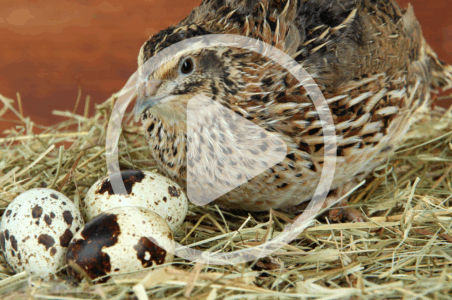
Kenny Coogan: What is [a quail’s] egg production look like?
Eric Stromberg: A coturnix quail lays around 300 eggs per year give or take, that’s gonna be dependent on a lot of different variables, just like a chicken, right? A chicken’s gonna lay 350 eggs a year, but if you’re not feeding it properly or it’s not lit properly, you’re not going to get those eggs. So what that equates to is each female quail will lay about five to six eggs a week once they’re into production.
So just, like a chicken, they’re gonna be more productive younger in life. So like the first year and a half is gonna be their most productive and then they’ll fall off from there. But that’s what you should be expecting. Now, how big is a quail egg? So I think it takes three quail eggs to equal a Bantam chicken egg. So it’d probably be about five to six quail eggs equals a full chicken egg. But they’re delicious. They taste the same. A lot of [00:01:00] people like to pickle them. A lot of people like to hard boil them.
I don’t currently have quail, but when I had them, I would scramble ’em up. I would eat ’em just like a chicken egg. They can be hard to crack, but they have these little scissors for that too. Yeah. It’s a fun process.
Josh Wilder: Welcome to the Mother Earth News and Friends podcast. At Mother Earth News for 50 years and counting, we’ve been dedicated to conserving the planet’s natural resources while helping you conserve your financial resources in this podcast. We host conversations with experts in the fields of sustainability, homesteading, natural health, and more to share all about how you can live well wherever you are in a way that values both people and our Mother Earth.
Thanks to Brinsea
We’d like to thank our sponsor for this episode, Brinsea. That’s B R I N S E A, chick incubation specialists. They’ve been focusing on egg incubator design continuously since 1976, resulting in egg incubators, chick brooders, and incubation accessories. They offer unparalleled practicality, reliability, superior hatch rates, and healthy chicks. Innovation you can trust.
Kenny Coogan: Good day everyone. I am Kenny Cogan, and joining me on this episode of Mother Earth News and Friends is Eric Stromberg. Eric is the director of the Poultry Division at Strombergs. Today we’re talking about raising [00:02:00] quail for meat and eggs. Welcome back to the podcast, Eric.
Eric Stromberg: Hello, Kenny. It’s great to be here.
I love talking about poultry and quail is a great subject. So
Kenny Coogan: yes, excited to be here. We’re excited to hear from you and we were just talking before we were recording. I just moved from Florida to North Carolina and I might be interested in getting some quail for myself. So I’m particularly interested in the subject.
Why raise quail?
Eric Stromberg: Quail they, I think a lot of people are interested in quail, especially when you might not have a lot of land, and I don’t know what your circumstances are, but a lot of people will raise quail for the same reasons why people raise chickens is because they want to control their own food source.
And they also, they want a high quality meat and a high quality egg, which okay we’re talking a miniature [00:03:00] version of a chicken kind of it’s different, but that’s what you think of it as is, okay, I’m gonna get smaller eggs and I’m gonna get smaller meat. But they are both prolific, so that’s why I think a lot of people start going down the path of raising quail.
Benefits of Raising Quail
Kenny Coogan: Can you talk a little bit more about the key benefits of raising quail for meat and eggs compared to chickens and other poultry? I’m assuming they’re gonna eat less.
Eric Stromberg: Yep. So they are, they’re going to eat less and they’re gonna take up a lot less space and a lot less noise. A lot of people that raise them are in urban settings because you can raise them. You don’t have to have a large chicken coop and a large chicken run. Many people raise them in garages or sheds, and they’ll use what’s called a battery cage. That’s just a cage with different levels. It’s like an apartment building for quail is how I would put it, is you’re gonna have a cage generally they’re sloped, so when the bird [00:04:00] lays the egg automatically rolls out. And a lot of people are going to quail because less space. High quality meat, high quality eggs, less feed, less noise.
Hatching Quail with Incubators
Kenny Coogan: What are some of the first steps in getting started with quail farming?
Eric Stromberg: One of your biggest challenges with quail and also rewards is that a lot of times hatcheries or breeders do not want to ship quail chicks. We work with a partner that ships quail chicks for us.
Probably the first question that you have is, all right what am I getting myself into here?
Usually people are choosing between a bob white quail or a coturnix quail, and that would be for meat and eggs. Now, bob white quail are more of a wild bird, so most people are going to go towards the coturnix quail, which is like a domesticated version of quail. And so pretty much for this [00:05:00] conversation we’re gonna talk about coturnix quail.
And there are some variations of coturnix quail. We sell a variation called the Texas A and M, and that was actually developed by research at the University of Texas A and M to have a quail that would both lay eggs, prolifically, and be a good meat bird. But most people just use like a either coturnix or a jumbo coturnix quail.
So one, let’s keep going along those lines, is what’s one of the big challenges that a new quail raiser’s going to face? Usually you can only get fertile hatching eggs, and so the first thing that they’re gonna be faced with is they’re going to have to incubate their own eggs. So that can be a challenge, but it’s easily overcome.
There’s a lot of variety of incubators on the market, and so you can get something [00:06:00] for very little amount of money or you can get up for a lot of money. That is going to be one of your first hurdles, right? So what kind of incubator do you want?
I try to steer customers away from the very bottom end of the incubators. There are some really good styrofoam incubators out there still. GQF makes one. Miller Manufacturing makes one. However, there is a flood of foreign incubators on the market that don’t work that great. And so that’s one thing that you wanna avoid.
If it sounds too good to be true, it probably is too good to be true. Use a trusted brand. When you start to get into the more expensive incubators is automation. All you are doing is controlling four factors for those eggs to get them to hatch.
You’re controlling temperature, humidity, airflow, and turning. So the better the incubator, the better the thermostat, the better heating units. So that’s controlling your temperature, right? What that’s going to do also is there’s gonna be still air incubators and [00:07:00] there’s gonna be forced air incubators.
Forced air incubators are just gonna circulate the air and keep the whole incubator at the same temperature. So that’s one feature that you’re gonna wanna look for. Humidity that’s also critical for hatching. So coturnix quail take 18 days to hatch. So your first 15 days, you’re gonna watch your humidity a little bit lower at about 50%. Then the last three days, you’re gonna wanna up that to 65%. That’s what you’d be, that’s the hatching timeframe. And just things that you’re gonna want to think about also is the airflow of the incubator. Yes incubator can have the right temperature, the right humidity, but you have to think of an egg as a living thing. So it still needs oxygen, right? So there needs to be some airflow there. And the last thing is turning. You’re gonna have to turn those eggs at minimum three times a day. So if you get an incubator that doesn’t have an automatic turner, you’re gonna wanna turn ’em hey by hand three times a day. [00:08:00] And what we say is you always wanna do a turn them an odd number of times per day so that they’re always on a different side.
And then from there, they’ll stop turning at that 15 day mark and let them hatch. Then they orient themselves and hatch out. If you have an automatic turner, put the pointy side down. So that’s the quick and dirty version of how to hatch coturnix quail. There is many different versions and methods of incubating out there.
So read up about it. But that’s my quick version of incubation. That is one of your biggest challenges is that you’re gonna be getting quail eggs right away.
What to do with male quail chicks?
Kenny Coogan: So hatching quail eggs will probably lead to male chicks. Do backyard raisers care about this?
Eric Stromberg: Coturnix quail do well in [00:09:00] captivity. However, you do want a certain ratio of males to females. So that. The males don’t how do I put this?
Kenny Coogan: Bombard
Eric Stromberg: Overwork the females. Yes. I dunno, I didn’t think that’s here before the interview there. So anyways you don’t want so many males that your females are being overwhelmed. And so what a lot of farmers do is they will harvest the meat from the males.
That’s a normal process. And just like when you get straight round chicks, that’s what you’re going for is you’re gonna start harvesting the meat of the quail. And that’s what you’re really going for anyways, is you do want a good ratio so you can have both the meat and the eggs.
What age can you harvest quail meat?
Kenny Coogan: What age can you harvest the quail?
Eric Stromberg: Usually it’s six weeks, so it’s a real quick turnaround. You will be surprised how fast they grow. They it’s almost like they double in size. It. It’s [00:10:00] it’s like before your eyes all of a sudden you’ll go and check on ’em the next day and they’ve doubled. Which it’s, and that’s what is fun also, is that you can see instead of a chicken where you’re waiting to see the lifecycle take place you can see everything real quickly. Whether that’s the hatching, instead 21 days, it’s 18. They’re gonna be laying eggs at five to six weeks. They’re gonna be ready to butcher at five to six weeks. So you can see the lifecycle of a bird much faster.
What age can you sex quail chicks?
Kenny Coogan: What age can you sex coturnix quail?
Eric Stromberg: It’s gonna be about in that same age range, I would say. You’ll start being able to sex them.
Do neighborhoods or HOAs care about backyard quail?
Kenny Coogan: Do neighborhoods or municipalities or HOAs care about raising quail like they do for chickens?
Eric Stromberg: That’s a good question. That’s hard to answer. I’m sure they do care. I have never heard any [00:11:00] quail specific regulations on what you can do.
So let’s say you have group of 12 chickens and a group of 12 quail. The quail will be so silent your neighbors wouldn’t even know unless they were really paying attention. The roosters do make a noise, but it’s it sounds, it’s quiet for one, and it sounds so much like a wild bird you probably wouldn’t notice it unless you really knew what you were looking for. I hear more about people stealth raising quail we’ll say than anything else just because the regulations don’t seem to apply. They don’t eat that much. They don’t have a lot of waste. So I think a lot of people fly under the radar, if you will, for quail.
Kenny Coogan: My backyard neighbor in Florida raised a lot of coturnix quail, and he had. Like the Pharaoh, wild type yeah golden, white, oh [00:12:00] yep, silver, pied,, blue, cinnamon. And there’s probably a lot other color variations, which a lot of chicken breeders are familiar with about the different breeds and the different color varieties.
Eric Stromberg: So I would say with chickens like there’s more, there’s color variations, but there’s also breed variations where with coturnix you’re gonna get pretty much the same characteristics, right? However, they’re just have a different coloration. It makes your flock prettier, but it’s not gonna change your egg production or meat production, let’s say.
How good are quail at laying eggs?
Kenny Coogan: Speaking of that, you mentioned that you can harvest quail at about five to six weeks old. You probably wanna do mostly the males and then the females will also start laying.
Eric Stromberg: Yep.
Kenny Coogan: What is their egg production look like?
Eric Stromberg: A coturnix quail lays around [00:13:00] 300 eggs per year give or take, that’s gonna be dependent on a lot of different variables, just like a chicken, right? A chicken’s gonna lay 350 eggs a year, but if you’re not feeding it properly or it’s not lit properly, you’re not going to get those eggs. So what that equates to is each female quail will lay about five to six eggs a week once they’re into production.
So just, like a chicken, they’re gonna be more productive younger in life. So like the first year and a half is gonna be their most productive and then they’ll fall off from there. But that’s what you should be expecting. Now, how big is a quail egg? So I think it takes three quail eggs to equal a Bantam chicken egg. So it’d probably be about five to six quail eggs equals a full chicken egg. But they’re delicious. They taste the same. A lot of people like to pickle them. A lot of people like to hard boil them.
I don’t currently have quail, but when I had them, I would [00:14:00] scramble ’em up. I would eat ’em just like a chicken egg. They can be hard to crack, but they have these little scissors for that too. Yeah. It’s a fun process.
Kenny Coogan: And they’re expensive at the grocery market, which we’re gonna talk about after the break.
Eric Stromberg: Okay. That sounds good.
What to feed quail
Kenny Coogan: What about diet? Do people feed the layers different than the meat birds or, and what are quail in general eating? Or what should they be eating?
Eric Stromberg: The biggest difference between a quail and a chicken is that they grow so fast. So when they’re young, they’re going to need a higher percentage protein in their food.
They’re going to need a 28 to 30% game bird starter feed, and those protein ratios can vary a little bit, but I say I would never go like below 28 or 27. Usually what you’re gonna find at a feed store is going to be gamebird starter. That would be ideal.
You can find turkey starters. [00:15:00] Sometimes they’ll call it all flock, but really what you’re looking for is that protein percentage to be real high, and that’ll help them put on the weight and develop their fathers fast enough.
Quail health
Kenny Coogan: What are some like the biggest quail health concerns maybe in even regards to getting improper protein or are they a generally hardy bird? Because I know we’ve bred to exhaustion dogs and chickens and some of ’em do have problems. Yeah. But a quail is a pretty wild type bird still.
Eric Stromberg: They are. This is. I always tell my customers, especially my first time customers, this is gonna be your biggest hurdle is all right. Your birds come, or they hatch quail are so small, they’re born to die, which sounds horrible, but they’re very fragile at that. We’ll just say like that 24 hour to 48 hour window, which let’s face it, most birds are, [00:16:00] however, the reason why quail aren’t shipped around the country just like any other bird is because they don’t last in transit. And so that’s why we’re shipping hatching eggs. Now like I said some breeders have figured it out and they will ship you quail chicks. We have a great survivability.
However, what I would always tell a new customer is be very prepared for that first 24 hours, especially. If it’s your first time. Let’s talk about some of those health issues. You wanna make sure your brooders all set up and ready to go. You’re gonna wanna make sure you have feeders and waters that are specific for quail.
You’re gonna wanna make sure you have that specialty feed right on hand. And then what I also suggest for those customers is for that first 24 to 48 hours is grind up their quail feed. Make it smaller so the quail can ingest it faster and better. But also usually chickens you keep at 95 degrees for the first week, I up that temp to about a 100 for quail.
I also make sure [00:17:00] that I have a vitamin electrolyte supplement in the water for the quail right away. And so getting over that hurdle for quail chicks. Right when they’re going into the brooder is probably one of the biggest hurdles that you’re gonna have. Also let’s talk about some health issues as they develop. A lot of people are raising quail on wire, which means they’re not actually on the ground, they’re on wire. You can avoid a lot of health issues that way because they’re not on the ground. If they are on the ground, you’re probably gonna have some warming issues and you’re gonna have to deworm your quail every now and then, just like you would a chicken. Use a specific worm for those birds and just follow the instructions. Otherwise, just like any other poultry watch for coccidiosis, things like that, you could treat that with apro. But generally, I would say that quail are a very hardy bird.
Quail coops and enclosures
Kenny Coogan: So speaking of the wired flooring, what type of enclosures and housing [00:18:00] are good for quail?
Eric Stromberg: Most people build their own or buy what are called battery cages for quail. During the brooding process, you’re gonna have to keep them warm until they feather out. Then you bring ’em out to their area. Just like any other poultry, you wanna make sure that it’s dry. So you either gonna have the litter be dry, or you’re gonna have the droppings go through to a dropping pan that you’re gonna be keeping constantly cleaned up. Because a dry coop or a dry pen is a healthy pen, so then you’re also gonna want it to be lit.
And just have really good accessibility to food and water just like any other chicken with quail. A lot of times people will remove the when chickens or quail or any bird have food, they do what’s called billing out and they sift through the, it’s like when you look in your refrigerator.
I use this example all the time. It’s the same food, but you still open up your refrigerator. You look in the, essentially what a [00:19:00] chicken is doing when it does that or a quail, they’re doing the same thing. It’s the same food they’re just looking for through it to see if there’s anything else. When there’s, so a lot of times quail raisers will remove the anti-billing out properties from their feeders because the quail sometimes have a hard time using the feeders because they’re so small.
Or sometimes they’ll use, they’ll make their own for water. I did, I brought this. All it is it’s a small cup. Most quail raisers, once the quail gets to about three to four weeks, they’ll use these little cups and it’s just makes it easier for them to clean. And it gives the quail a clean water source at all points in time. It’s a small cup, reaches through the caging and sits in the cage. There’s two different styles. This one is a trigger, so the quail actually have to hit this trigger to get the water. There’s also a little float valve style as well, but a lot of people will use those
Kenny Coogan: For inside the [00:20:00] enclosure. I don’t know if we call it a coop, because there’s usually smaller. But for inside the enclosure, are we providing them perching we would like a nighttime roost?
Eric Stromberg: I it depends on your setup in brooding or in the battery cages. I’ve never seen anybody providing it. When I have raised them on the ground, I have always provided it. So the battery cages, usually they don’t have as much amenities because they’re really just being raised for those eggs and they’re really in a small area. However, when I’ve raised them in pens and like more of a natural setting, then I’ll provide them with all the amenities of outside feeders, waters roosting.
But I, I think quail like to stay they kinda like a safe area, not so much of a roosting area. Does that make sense?
Kenny Coogan: Yeah. Our neighbor. He had a six by [00:21:00] six coop, and then he would throw in a evergreen tree or a branch in there and they would hide under there.
Eric Stromberg: Yeah, think of a covey of quail. They like to hide in thick brush and stuff like that. So not necessarily roosting areas, but hiding spots.
Do quail need nest boxes?
Kenny Coogan: Now the internet tells me that I should ask you, do you need nest boxes for quail? And when I visited our neighbor who raised 40 quail, they were eggs peppered everywhere.
You had to watch where you were stepping because they would just release them wherever they were at the time.
Eric Stromberg: That is more common than the nesting boxes for quail. As with any bird, I would always watch the behavior of the bird. A lot of times you can try to get them to lay in corners.
That’s what a lot of people do. And that’s just encouraging them to lay maybe darkening the corner a little bit, things like [00:22:00] that. But like you said with quail, I’ve usually found that they’re just laying wherever they want. A lot of people are using these battery cages that are roll out, so they don’t care where the birds lay.
Do quail need vaccinations?
Kenny Coogan: Are there any vaccinations that you would recommend for quail or are there any vaccinations available for quail?
Eric Stromberg: I have never heard of any quail vaccinations now am I, a vet? No, but in all my years of the business I’ve never been asked that question but I’ve never heard of any vaccines. No.
Kenny Coogan: We’re going to take a quick break to hear a word from our sponsor, and when we return, we’ll be talking about raising quail for profit.
Thanks to Brinsea
Brinsea products are designed to be long lasting and energy efficient. Their Advance Series incubators and brooders feature the latest state of the art digital control systems, providing instant readings of temperature and humidity to ensure successful hatches and healthy chicks.
Check out Brinsea incubators and more at www.Brinsea.com. That’s www.Brinsea.com.
Kenny Coogan: We are back with Eric Stromberg. Eric is the director of the poultry division at Strombergs.
How to sell quail products?
Kenny Coogan: Eric, do you have any advice on how to market and [00:23:00] sell quail products to stand out in a competitive market, and I was mentioning earlier that quail eggs at a grocery store are so expensive.
I feel like if you go to a social media outlet and you post, Hey, here’s some fresh quail eggs, I think it could be a winner depending on the market and where you live.
Eric Stromberg: Selling quail eggs and meat into a market would be yes, packaging is key. Standing out is key. A lot of people, what we see is they’ll raise them in the country and they’ll market them into the city. Just kinda like what you’re talking about, because that’s where people are looking for that type of thing.
I’m not saying you can’t, it’s just the concentration of people that are looking for quail. In general in the cities is higher. So how do you get to those customers? Let’s just say our first step is no matter where you wanna sell it, is that you’re probably gonna have [00:24:00] to have a USDA inspected -if you’re gonna sell the meat- facility, help you with that.
Now, for the eggs, usually you’re going to be below any bird thresholds that are gonna make you do any inspections and things like that, just like chickens. So you’re not gonna have to worry about that. But once you’re past those two hurdles, then you’re going to also want to just make sure your presentation is correct and looking great.
A lot of people are selling their quail to higher end restaurants, and we see customers doing very well with that and into farmer’s markets. With that consistency is key. You always want to have the, your product there on a consistent basis. So let’s say your farmer’s market’s there every Saturday.
You wanna make sure you’re there selling your quail every Saturday. And fortunately with quails, they are prolific egg layers. And once you start raising them, you can even start incubating and hatching your own eggs. You should always have a supply is what I’m getting at. So you should be [00:25:00] able to consistently supply these farmer’s markets and restaurants if you so choose to. Another thing that we’re seeing our customers being successful with is actually setting up websites and having people order frozen meat or fresh eggs and getting them delivered to their homes just like anybody else would. So we have had some customers have success with that.
In a competitive market, let’s say I’m raising quail here in Minnesota. I know what it’s gonna cost me to ship, 10 pounds of quail down to anywhere, at this point in time with next day. Or you can get it anywhere. You just bake those costs in and if somebody wants ’em, they’ll order ’em.
Where to learn how to butcher quail?
Kenny Coogan: We are not gonna be talking about the specifics of harvesting the quail for meat, but where would one go to find information on humane and efficient processing of quail. For instance, if you’ve never done it before, where would you start to learn how to harvest your own [00:26:00] meat or specifically quail?
Eric Stromberg: My first step I always recommend like the Storey’s guides. There’s a Storey’s Guide to Poultry Raising. That’s an excellent read. Now most people aren’t using books anymore. Most people are going to YouTube. There’s a lot of people that are out there that are really talented at showing exactly the process.
I think there’s one Myshire Farms and the Couturnix Corner. They do a great job with it. There’s a lot of resources out there, and the nice thing about when you are harvesting your own meat with poultry, you’re in the driver’s seat and making that as humane as possible. So you’re trying to keep those birds as calm as possible until the end.
You’re controlling their diet, you’re controlling their life and you’re also controlling that end of life process. So just take it upon yourself and really do the research whether it’s reading or using reputable YouTube [00:27:00] people, and just ma then make your best decisions.
Kenny Coogan: I have the Storey’s Guide to Raising Ducks by Dave Holderead and the spine is broken. And I love that fact about my book. I’ve used it so many times and I’ve referenced it so much.
Eric Stromberg: Yeah. Those are excellent books. I can’t say enough good things about that whole series, so you can really take your education in your own hands with those,
Kenny Coogan: okay, Eric, the last question is, can you give me some numbers? What would the startup costs look like or what are some like ongoing expenses?
Eric Stromberg: It really varies and I know this is a cop out, how skilled you are and what kind of space you already have.
So there’s a lot of really quality battery cages for quail out on the market. And you can get a section of quail battery cages for a hundred bucks. You can build them [00:28:00] probably cheaper that yourself, but it’s gonna take you time. Your biggest expense as with any poultry raiser is gonna be your feed. And what I always recommend whenever you’re raising your birds is to watch their behavior. And we spoke a little bit about feed waste feeders that are trying to prevent that feed waste. And that’s gonna be your biggest problem is these birds are gonna be billing that feed out and every time they build that feed out, you can just hear the cash register ka-ching because that’s you going to the feed store and buying more feed.
I have seen quite a few really good homemade feeders out there that start to address this issue. And I would recommend really looking into that and just saying like, how can I stop my feed consumption from getting outta hand? So I know that’s a bit of a cop out, but your biggest thing is going to be feed and then your housing [00:29:00] if you don’t have an area to house them in, that’s like building the chicken coop.
And that’s gonna be another big expense.
Kenny Coogan: Thank you so much, Eric for talking to me today about raising quail for meat and eggs.
Eric Stromberg: Yeah, thanks for having me. I really appreciate it. I love talking chickens or poultry anytime. So if you have another topic, just let me know and we’ll get back together, Kenny and have another webinar.
Kenny Coogan: Thank you so much.
Eric Stromberg: All right, thanks, Kenny.
Thanks to Brinsea
Thanks again to Brinsea, our sponsor for this Mother Earth News and Friends podcast episode. You too can experience the Brinsea difference and maximize your hatch rates with Brinsea incubators that monitor temperature and humidity and are made of antimicrobial materials.
Brinsea ships worldwide and provides stellar customer support to answer all your questions. Hatch your chicks with Brinsea, the leader in innovative incubation research. Learn more at Brinsea.com. Again, that’s www.Brinsea.com.
Josh Wilder: Thanks for joining us for this episode of Mother Earth News and Friends. To listen to more podcasts and get connected on our social media, visit www.motherearthnews.com/podcast. You can also email us at podcast@ogdenpubs.com with any questions or suggestions. Our podcast production team includes Kenny Coogan, Alyssa Warner, and myself, Josh Wilder.
Music for this episode is the song Hustle by Kevin MacLeod. The Mother Earth News and Friends podcast is a production of Ogden [00:30:00] Publications.






