

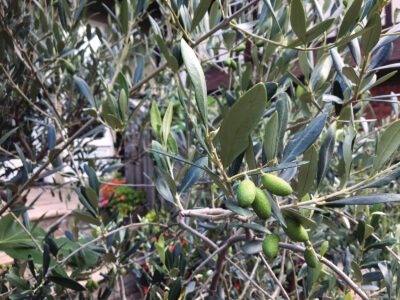
An olive tree is more than a food plant. The silvery-gray leaves shimmer in the breeze, making this Mediterranean crop beautiful too. If you’re not in a Mediterranean climate, you can still enjoy this lovely plant, because olive trees grow well in pots.
The common olive (Olea europaea) is a long-lived plant. In olive-growing regions, trees can live for hundreds of years. With care, even a potted olive tree can become a family heirloom.
Olive trees are as tough as nails. But to harvest olives, you’ll need to know what gets them to fruit – my trees didn’t give me a single olive until I figured it out!
Where to Get an Olive Tree
Buy a plant. If you’re shopping for an olive tree, there are many varieties, offering fruits with different shapes, colors, sizes, flavors, and oil content. Winter chill requirements and cold tolerance differ by variety too. Cold tolerance is less of a concern with potted olive trees, because they’re moved to a protected area over winter.
If you’re growing only one plant, it’s important to know that not all olive varieties are self-fertile – meaning you’d need two varieties to get fruit. If you’re starting with only one olive plant, choose a self-fertile variety. (The cultivar ‘Frantoio’ is self-fertile and widely available in the nursery trade.)
Grow from seed. If you like to grow plants from seed, keep in mind that seed-grown olive trees will go through a juvenile stage before fruiting. Once they fruit, you won’t know what to expect; like many other fruits, the seed-grown plants aren’t replicas of the parent plant.
Suckers. Olive trees often send up suckers from the base of the plant. This is the easiest way to get a new plant, as soil-level suckers often have some roots on them – and can be cut off and potted. Then, you can trade for other varieties with friends!
Cuttings. Nurseries propagate olives from cuttings. They’re not as easy to root as some plants. Keep some of the year-old wood when you prune in fall, making cuttings that are 8 to 12 inches long. Use rooting hormone. Keep conditions humid by covering with a clear plastic bag or a propagation dome.
How Hardy Are Olive Trees?
Hardiness is affected by many things, including the variety and age of the tree, whether it’s been acclimated to the cold, and how long the cold lasts.
Don’t let potted olive trees go much below freezing. A safe minimum temperature is 27 degrees F. The soil in pots freezes and thaws more quickly than in the ground, so move potted plants to a protected space to minimize the chance of damage.
Overwintering Potted Olives
In my Zone 5 garden, it’s too cold to plant an olive tree directly in the ground, though I did speak to someone who buries his potted olive tree in a trench over winter – much like some people do with fig trees.
You don’t need to rush your tree indoors for a light-frost warning; I leave my olive trees out through light frosts. Cold weather actually helps get olives to flower; they need 200 to 300 “chill hours.” Put the trees somewhere cool and bright over winter to encourage flowering. Aim for 40 to 50 degrees F.
Over the years, I’ve kept my olive trees in a variety of places. My dining room was too warm, so I didn’t get any flowers, but the trees looked nice decked out in Christmas lights! When my trees were kept in a minimally heated sunroom, there were flowers galore, and when they were kept in a cool greenhouse, there were also lots of flowers.
If growing a potted olive tree in a warm house for the winter is your only option, pick the brightest, coolest location possible. Know that an olive is not an ideal houseplant, and you probably won’t get olives if it’s grown as one.
Repotting Olive Trees
A good time to repot olive trees is before new growth begins, in late winter or early spring. If you start with a small olive tree, give it a bigger pot each year, as the roots will fill the pot. At some point, you’ll need to choose whether to give it a bigger pot (for it to grow), or to trim the roots back and put it back into the same pot so it won’t get any bigger.
Pruning back the roots can seem harsh – but think of bonsai, where decades-old trees are kept small by pruning roots and branches.
My olive trees are in 14-inch-wide pots, and that’s the biggest pot size I’ll give them. Otherwise, they’re too heavy for me to move down the stairs into my greenhouse for winter. But if you have a large pot on a dolly and can simply roll it into a sunroom, a larger pot and tree might be fine. A bigger pot will lead to a bigger tree and more olives!
When it comes to potting soil, I use a soilless mix for saplings. Then, as the olive trees get larger, I use a loam-based potting soil in the larger pots for moisture retention and weight. As trees get bigger, a heavier soil prevents them from tipping in the wind.
Potted Olive Trees in Summer
Potted olive trees do best when they’re outdoors for the summer. Pick a location with full sun; the small, thick, leathery leaves on olive trees make them well-adapted to hot, sunny locations.
Pruning Olive Trees in Pots
New plants. When starting with a small tree, the first step is to create a shape you like through pruning. The shape can be a bush, a tree, or something in between.
To create a tree shape, leave only the central main branch. To get it to grow straight, tie it loosely to a stake. The ultimate size of the plant is your choice; I keep mine 6 feet high so I can move them through doorways.
Pruning large plants. For many home growers, space is at a premium over winter. Prune larger trees in fall before moving them back to their overwintering location. Don’t shear back the whole plant like it’s a sheep. Selectively hand-prune, because flowers form on growth from the previous season, and if they’re shorn too aggressively, there’s no new wood for flowers.
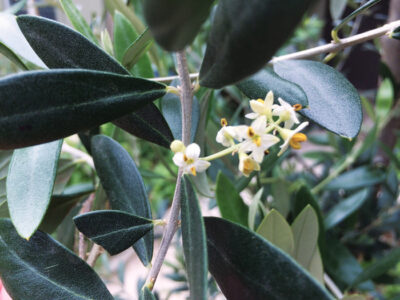
Olive branches are fairly flimsy, bending under their own weight. As a branch gets older and longer, it bends down. Younger, upward-facing growth appears closer to the center of the plant. This year-old, upward-facing growth should be left, while the drooping ends should get trimmed back.
Olive Pruning Checklist
- Remove crossing branches.
- Remove branches growing toward the center of the plant.
- Remove suckers coming from the base of the plant.
- Remove vigorous shoots growing straight upward, as these aren’t usually fruitful.
If you heavily prune an old, overgrown olive plant, it can grow new shoots from the old wood. When pruned heavily, the olive tree might send out a lot of new shoots. Leave only the ones you want; cut out the rest.
Water and Wind
It’s easy to think that because olives grow in dry Mediterranean summers, they don’t mind being parched – but don’t let potted olives get dry. Keep them well-watered, but not soggy. There’s no need for a special fertilizer; all-purpose works well. Start feeding in spring and keep feeding through summer. Don’t feed over fall and winter.
Olives are mostly wind-pollinated. On a windy day, you may see a cloud of pollen around a flowering olive tree. Some people like to help the process with a feather duster, though I haven’t found it necessary.
Harvesting and Brining Olives
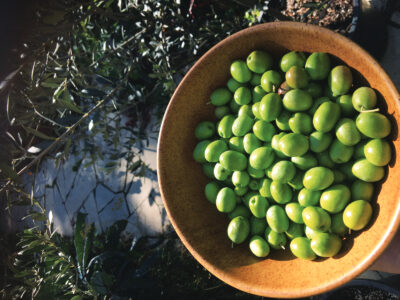
Olives can be harvested at different stages of ripeness: when they’re green and have sized up; once the juice inside is clear and no longer milky; as their color starts; or when they’re fully colored (the color depends on the variety). Once they’re picked, don’t eat them. Not yet. First, they need to be brined.
Freshly picked olives have pucker power. They’re bitter. After you’ve eaten one, you won’t do it again. Brining olives makes them edible. There are different ways to go about it. Here’s what I do:
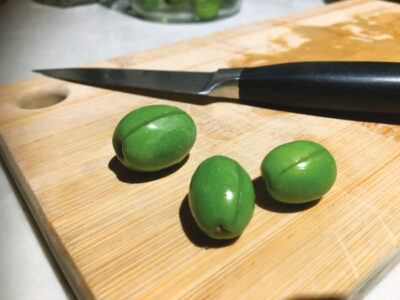
- Break the skin so the brine can penetrate the olive (crush the olive with the end of a knife handle, or slit lengthwise with a knife).
- Soak the olives in water for 10 days, changing the water twice a day.
- After 10 days, place olives in a brine (13 ounces of pickling salt per gallon of water).
- Leave the olives in the brine for at least two weeks and then taste one; if it’s too bitter, brine longer.
- When done, pour off the brine and marinate with red wine vinegar, lemon zest and juice, olive oil, crushed garlic, rosemary, and ground pepper.
Horticulturalist Steven Biggs shares his edible gardening and cold-climate fig-growing expertise at Food Garden Life.
Originally published in the December 2025/January 2026 issue of MOTHER EARTH NEWS magazine and regularly vetted for accuracy.





