

Learn how to make cheese from sour milk with this easy curdled milk recipe for making cottage cheese at home.
It happens. You buy a gallon of milk with good intentions but then an unscheduled trip out of town means it’s been in the fridge a little too close to (or even just past) the date on the carton. I love milk and I drink it often. In our home there’s always milk in the refrigerator. But an unplanned delay in us consuming it left it lightly soured.
But I won’t throw it away, oh no! There’s actually another delicious use for it: I’ll use the soured milk to make homemade cottage cheese! Thankfully making cottage cheese is very quick and beyond easy to do.
Curdled Milk Recipes
I had about half a gallon of milk remaining and it was just past the date on the carton. Of course, I’d never try this with spoiled milk, but lightly soured milk is perfect to use for making cottage cheese.
I poured that milk into a pan and heated it to 185 degrees Fahrenheit. I was careful not to let the milk get hotter than that since too much heat could change the texture of the curds and make them rubbery. Low and slow heat is best.
When my milk reached 185 degrees Fahrenheit, I added a tablespoon of plain white vinegar. Using a slotted wooden spoon, I stirred until the milk curds began to separate from the whey. When I’d stirred for about 3 to 4 minutes, I figured the curds were as separated as it would get.
Make Cottage Cheese at Home: Separate Curds and Whey
I turned off the heat and poured the hot curds and whey into a colander that had been lined with cheesecloth. There was quite a bit of whey, but even that byproduct’s not wasted. If I have whey available, I love to use it when making homemade bread. It not only adds a little extra nutrition but also more flavor.
I allowed the whey to cool and placed it in a glass jar and stored it in my refrigerator. I’ll be sure to use it the next time I make my homemade KitchenAid sandwich bread.
Meanwhile, I turned my attention back to those curds. They had now cooled enough to handle so with freshly washed hands I began crumbling those curds to the size I wanted them to be. I like a smaller curd, but you may want larger ones. The beauty of making it yourself is that you can enjoy it however you like!
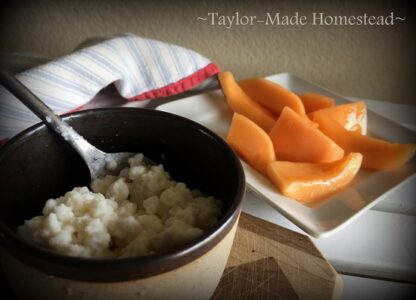
When the curds were the size I wanted I added about 1/4 teaspoon of salt (totally optional) and splashed in just enough fresh milk to give it a creamy texture. You could use cream or half and half instead for an even creamier texture. I typically just use fresh milk but skim, 2-percent or whole milk — it doesn’t matter to me.
Tammy Taylor lives and works on a Northeast Texas ranch, where she writes about home cooking, gardening, food preservation, and DIY living on her Texas Homesteader blog. Read all of Tammy’s MOTHER EARTH NEWS posts here.
All MOTHER EARTH NEWS community bloggers are responsible for the accuracy of their posts. To learn more about the author of this post, click on their byline link at the top of the page.