

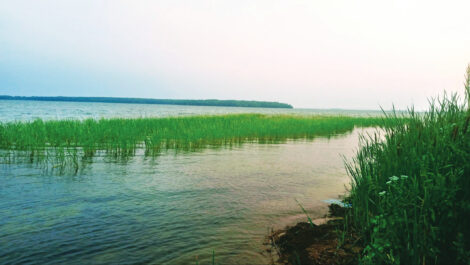
Where does wild rice grow? Meet people who protect manoomin rice, a culturally critical plant, and the waters that sustain it.
Leanna Goose (Anishinaabe) remembers wild rice, or manoomin, being served at every family get-together and funeral when she was young. She also recalls arguing with her parents to let her help with harvest as a 10-year-old: “I remember saying, ‘I’m a really good swimmer, I can go out there; I won’t fall in!'”
Goose’s dad knew where all the rice beds were and took her and her sisters out on the lake to experience the harvest. “He taught me how to pole, which is where you stand up and push the canoe through the rice bed using a forked pole. The rice in Mud Lake was so tall that I couldn’t see over it to know where I was going, and it was so thick that I could barely move us through it. My dad just said, ‘You’re doing good, keep trying to move us.’ I think about that now when I’m teaching my kids how to harvest manoomin. I want to have that patience and understanding with them, so they learn to love it like I did.”
Water as Home
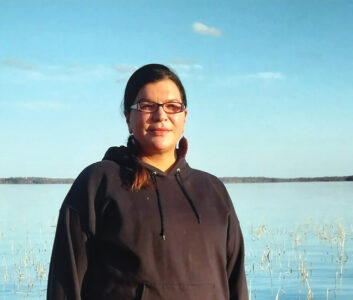
Goose lives off Leech Lake within the Chippewa National Forest in northern Minnesota. “The woods were my playground, and the water was my home. My father and I spent a lot of time out on the water setting net for fish and harvesting manoomin. So I really understand that if we care for the water, it will care for us. If we care for the land, it will care for us.”
Mud Lake was one of the first places Goose experienced manoomin. When she visited the lake as an adult with her kids, she was shocked by how reduced the rice beds were: “There was nothing there compared to what once was.”
Leech Lake has also seen a decrease in its wild rice beds; the lake’s Headquarters Bay now covers less than half the area it covered two decades ago. This trend is reflected across Minnesota, according to the Governor’s Wild Rice Task Force, with threats including pollution, climate change, and invasive species affecting the waters where wild rice historically flourished. Witnessing this loss drove Goose to the work she’s doing today to protect and restore manoomin – ”so that my children will have it when they need it.”
To grasp the significance of manoomin to the Anishinaabeg, Goose says, it’s essential to understand their history. “Long ago, the Anishinaabeg lived along the eastern shores of the Atlantic Ocean, until sacred prophecies led to a westward migration to the place ‘where food grows on water.’ Trusting this vision, the ancestors followed a sacred journey to the Land of 10,000 Lakes and the surrounding regions,” Goose says. “Since then, the Anishinaabeg’s purpose is clear: to safeguard wild rice and the waters that sustain it.”
Much of the land that became the state of Minnesota was ceded by Dakota and Ojibwe people to the U.S. government in the mid-1800s through a series of treaties that also established reservations – fractions of the tribes’ original homelands – where members were forced to move and live. “It’s a painful thing to think about, not just what happened here in Minnesota, but what happened all across the United States to Indigenous peoples,” Goose shares. She also feels immense gratitude to her ancestors who ensured treaty reserved rights to hunt, fish, and gather in the ceded territories. “Our people understood the tiny reservations that we were set onto wouldn’t be able to sustain our people throughout the generations. I feel that strong sense of responsibility to protect my homeland and the places where my ancestors wanted us to have these rights to hunt, fish, and gather. [When I was] growing up, my dad showed us how to practice our treaty rights, and in doing so, he really helped [me] establish a connection to the land around me. I want to protect these treaty rights so my children have that connection to the land too.”
A Season with Manoomin
Minnesota has more acres of wild rice than any other state. The plant typically grows in shallow water around lakes and in streams and wetlands, but it’s also found in some rivers. Wild rice reseeds itself every autumn, the ripe seeds falling from the tall grass into the water and down to the muddy bottom, where they overwinter, requiring freezing temperatures to spur their germination the following spring.
In early summer, new growth of the wild rice plant appears to lay on the water. This floating leaf state is a sensitive time when major changes in the water level or other disruptions from extreme weather or human activity, such as boating, can harm or uproot the plant. Goose has seen more washouts of wild rice beds as heavy spring rainfalls have become more common and worries that the bad years are starting to outnumber the good.
The floating leaves begin standing up as summer advances, and by July, rice is forming on the now-tall grass. Goose typically harvests wild rice in the first half of September. A respectful harvest, she says, starts with scouting where there will be a good harvest and where the rice bed needs to rest. “If it’s been a bad year for the rice, maybe that’s a place you don’t go, so it can reseed itself and hopefully recover the next year.”
Goose and her kids explore different lakes, seeing how the manoomin looks and testing for ripeness. Goose runs her fingers through the top part of the grass where the rice is. If nothing comes off, the rice is still green; ripe rice will fall easily into the water or the harvester’s canoe. Traditional hand-harvesting involves using one stick to pull the plant over the canoe and tapping, or “knocking,” the grass with another stick to free ripe seeds from the plant.
When Goose and her sisters were out on the rice bed with their dad, he’d have them throw a handful of manoomin back into the water before leaving. “It didn’t click when I was a kid,” Goose says. “My dad was someone whose actions spoke louder than his words. He was teaching us, but he let us figure it out on our own. Now I know this is part of the traditional harvest – sprinkling those seeds to ensure the person who comes behind you has some of that plant too.”
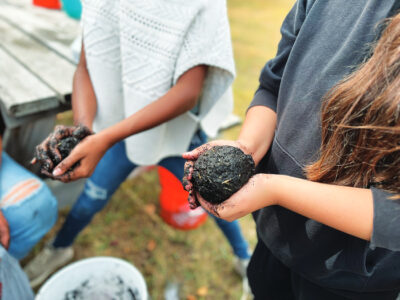
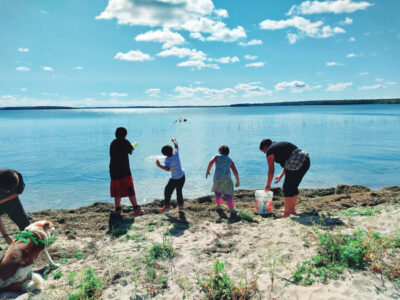
Goose has started reseeding with mud balls, using dirt from the lake shore to form a ball with rice seeds and dropping the balls in the water. “Reseeding with manoomin packed in mud helps bring it down to the sediment and get a little head start. I was told from an elder, who heard from another elder, who heard from another elder – that’s Indigenous ecological knowledge right there!”
Ecosystem Indicator
Like humans, wild rice plants need clean water. “I’ve heard it called the ‘canary in the coal mine,'” Goose says, “because if this plant is beginning to disappear, we should be paying attention. Manoomin is an indicator of good water quality, and all life depends on clean water, so this plant can tell us a lot about our ecosystems here in Minnesota.”
Across the Great Lakes region, wild rice beds provide cover and nesting habitat for birds, and they’re a crucial source of food for waterfowl, whose fall migration coincides with the maturation of the rice seed. Fish and wetland mammals make homes among the rice plants, both above and below the water, and the plants work in concert with the water to store sediment and filter pollutants, improving the quality of water downstream.
But manoomin is also sensitive to water pollution, including from sulfate, which has been shown to impair seedling survival and decrease mature seed production. Sulfate is naturally occurring, but it also enters fresh water through mining activities, agricultural fertilizer runoff, and wastewater. Microbial activity that converts sulfate into sulfide can result in toxic levels of sulfide in the sediment, creating an inhospitable environment for wild rice. High sulfate levels in water are also linked to harmful algae blooms and the production of methylmercury, which contaminates fish and makes its way into humans.
Northern Minnesota has a history of extractive industries dating back to the 1800s. Pressure from settlers interested in mining influenced the negotiation of the 1854 Ojibwe Land Cession Treaty. Within the Leech Lake Indian Reservation, where Goose lives, a decades-long cleanup of a designated Superfund site continues. In Aitkin County, just over a mile from Anishinaabeg homes and near waters that host wild rice, a proposed nickel-copper mine would use sulfide mining to extract the metals, a process that puts lakes, streams, and wetlands at risk. “When that nickel is pulled from the ground,” Goose explains, “it’s wrapped in sulfide ore, which reacts with air and water, creating sulfuric acid, which has the same chemical composition as battery acid. No sulfide mine operating in a water-rich environment has been able to protect water quality. It’s a mistake we can’t afford to make, especially here in Minnesota, where we have abundant manoomin and fresh water.”
Climate Change Compounding
Stronger storms, drought, warmer winters – ”All of these threats from climate change are wreaking havoc on our ecosystems and on the wild rice too,” Goose says. One big storm could knock out an entire rice crop within minutes. Low water levels from drought can affect the growth and health of wild rice. “We’re also watching how these warming winters will impact the growth of our wild rice. The manoomin needs the cold in winter to help it germinate, and the warmer temperatures are favoring invasive species and pests.”
The decrease in size of the rice bed on Leech Lake aligns with the arrival of Eurasian watermilfoil in the mid-aughts, Goose shares. The invasive aquatic perennial forms dense mats at the water’s surface, where it blocks sunlight and outcompetes native plants, including wild rice. A chain of ecosystem impacts ensues, including reductions in food sources and habitat for fish and wildlife. The Minnesota Department of Natural Resources tackles Eurasian watermilfoil with both mechanical removal and herbicide treatment.
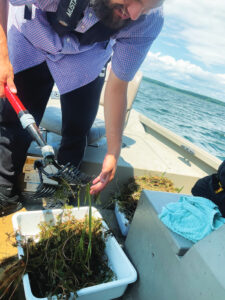
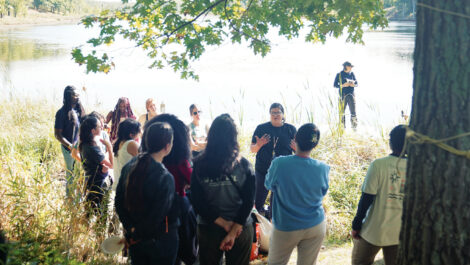
From Goose’s perspective, putting chemicals into the water is “trying to solve one problem by creating another.” She and a team from Leech Lake Tribal College and the Leech Lake Band of Ojibwe Division of Resource Management, funded by the Minnesota Department of Agriculture, have embarked on a multiyear project to investigate the impacts of invasive species on wild rice and restore impacted areas. Over the course of a summer, the team mapped out the locations of invasive species and rice beds on Headquarters Bay. Next came the removal. Using a pontoon equipped with a shop vacuum and divers, the team will remove invasive species from the survey plots where Eurasian watermilfoil is present. Wild rice will be reseeded in the survey plots and compared with control plots the following season. Goose and her son have been collecting Eurasian watermilfoil, which is high in nitrogen, composting it, and adding it to the corn they grow. “That’s part of Anishinaabeg culture too – anything we take from the Earth, we try to use respectfully.”
Goose is currently organizing with the Rise and Repair Alliance to advance the Wild Rice Act in the Minnesota legislature. The bill would recognize the cultural significance of wild rice and include protections to ensure its availability for future generations. Goose points out that as the Anishinaabeg people fight to protect wild rice and fresh water for their people, they’re also fighting for all people: “What happens here in these Minnesota waters flows up to the Arctic Ocean and down to the Gulf of Mexico. Water is interconnected.”
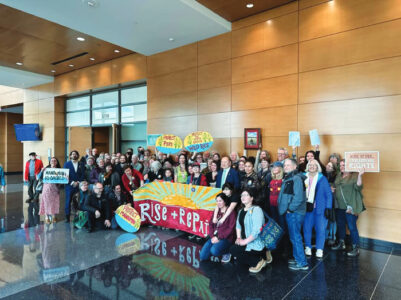
Wild rice that’s located within reservations has strong protections from the tribes, including their own water-quality standards and pesticide ordinances. “A lot of wild rice is located within treaty territory, but off the reservation,” Goose says. “So this legislation is really about protecting the Minnesota state grain and ensuring that it remains for current and future generations to enjoy.”
As summer unfolds in Minnesota, Goose is turning to projects on the land, including the ongoing removal of invasive species on Leech Lake and teaching young people about wild rice restoration. Fall will bring another harvest and another opportunity to have manoomin-packed mud-ball-throwing contests on the lake with her kids. “If humans are at the root of these problems, then we also have the power to be the solutions.”
Sarah Hunt works with the Climate Land Leaders Initiative, which provides support for those wanting plant, animal, and human communities to thrive through land stewardship.
Originally published in the October/November 2025 issue of MOTHER EARTH NEWS and regularly vetted for accuracy.





