

Deter invasive slugs with these organic slug control methods. Gardeners in this Southeast Alaska village have come up with creative and natural slug repellent techniques — and, in the author’s case, have come to embrace the wonder of black slugs.
When I was offered a chance for some deep, rich, earth for gardening in a tiny Southeast Alaska village, I asked if there were any black slugs in it.
“If you’re going to garden here, you have to just get used to them!” a resident curtly responded.
And with that began my battle and fascination with the invasive giant black slug, Arion ater.
Tenakee Springs in Southeast Alaska, with a population of 120 souls in summer and possibly a third of that in winter, lies 45 nautical miles south of Alaska’s capital, Juneau. Sitting on Chichagof Island deep in the Tongass National Forest, the largest national forest in America, Tenakee Springs is surrounded by second-growth and old-growth forest.
Southeast Alaska is blessed with close to 18 hours of bountiful summer sunshine, abundant water, dirt from the forests, and rich alluvial soil from its many streams and rivers, so it’s an ideal place to garden, despite this pest. I once lived in Skagway, the self-proclaimed “Garden City of Alaska,” 90 miles north of Juneau. But I never encountered black slugs before moving to Tenakee Springs. And now, I’ve adopted some of the organic slug control methods local gardeners use to deter or kill them.
Invasive Black Slugs Create Conservation Concern
Like so many invasive species changing ecosystems worldwide, the black slug’s journey begins far away; the slugs were transported either by ship or plane, secreted in soil, food, and lumber shipments. The Alaska National Heritage Program (ANHP), part of the Alaska Center for Conservation Science at the University of Alaska, Anchorage, keeps track of invasive species as well as the state’s animal and plant species and ecosystems and their ranking as a conservation concern.

ANHP published an invasiveness ranking for the black slug based on distribution, biological characteristics, ecological impacts, and feasibility of control. These categories were assigned points, and Arion ater received a score of 62 out of 100, or “moderately invasive.”
Arion ater is present in Anchorage, Cordova, Yakutat, Gustavus, Juneau, Sitka, Tenakee Springs, Ketchikan, and Kodiak Island, according to the Alaska National Heritage Project. Black slugs do provide some positive effects on seed and spore dispersal in the forest through their fecal matter, but for gardeners, their presence is a never-ending chore and source of frustration, creating demand for natural slug repellent. Boasting 27,000 teeth, the black slug is a natural wonder of machine-like destruction. Its flexible band of microscopic teeth, called a “radula,” acts like a circular saw, and it can grind through your garden plants without slowing down.
Organic Slug Control
Every July 4, Tenakee Springs used to have a slug toss, but residents decided that was perhaps too callous an approach to a creature just living its life.
One Tenakee Springs resident walks down the trail most days and cuts slugs in two — an organic slug control method that’s considered humane and that does not cause the slugs to grow back either segment.
Because slugs have simple nervous systems and lack a cerebral cortex, researchers surmise they don’t experience pain. But I once saw several slugs surrounding their mangled comrade, and because I tend to anthropomorphize every life form, I asked my trusty companion Bruce Ware whether they were mourning their fellow slug. “No, they’re eating it,” he replied.
So while I find the lack of compassion between slugs disappointing, the halving method does lure other slugs for an easy kill and circumvents the tedious search for slugs among the vegetation. I prefer to chop them directly in the head, because I think it kills them instantly, and if they do detect pain, then it is but a brief stab.
Other Tenakee Springs gardeners have their own preferred natural slug repellent techniques. Most spring mornings, you can see resident Joni Gates down on the shore of Tenakee Inlet picking seaweed for her garden and gathering clam shells to befuddle slugs attempting to enter her property, which she says is usually successful. And among the white jumble of sharp, broken clamshells, her flowers are a standout every summer.

Joni also uses tongs to lift the slugs and dump them into a container of seawater. Most Tenakee Springs gardeners use tongs with rubber ends to grip the slug securely. No one ever picks them up by hand, because of their three noxious forms of mucus; the first two are thin and aid locomotion, and a thicker one is secreted along the slug’s length, with all contributing to the slug’s wave-like motion.
In the Tenakee Springs Community Greenhouse, gardener Carlene Allred is vigilant for any interlopers, and carefully inspects the soil and improves it with organic pellet fertilizers and seaweed slurry.
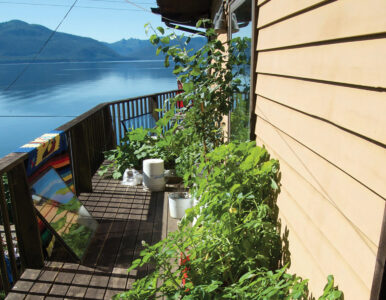
I decided my deck, 20 feet off the ground, would be a safe place to plant in containers, and I ordered 100 pounds of soil from a hardware store in Juneau. I also began to raise plants in the house by a big window that gets lots of sunlight. I didn’t see slugs, but I did have to fight fungus gnats by spraying soapy water on the soil.
But were there truly no slugs?
Finally, one day, I saw a slug beside the sliding door near the table my seedlings were on, and another outside the same door. Did they shimmy up the gutter drainpipe? I’ll never know. But I did create an organic slug control beer trap in one container, as slugs are attracted to beer’s yeasty scent, and no other slugs ever appeared in the brew.
I also built a raised bed out of a picture-window packing crate, which came with 6-inch sides and a particleboard bottom. With 2x4s added for height at each corner, chicken wire to keep deer out, and plastic overhead to deal with rain, I was able to grow a good crop of broccoli. I kept slugs from crawling up the legs with a smearing of Vaseline (any kind of grease seems to act as natural slug repellent by fouling up the slugs’ movement) and I’d find them curled up lifeless on the ground.
Other methods of organic slug control include tenting seedlings or making homemade barriers of sawdust, crushed eggshells, ground oyster or clam shells, soap, or cinders from the fireplace.
The Wonder of Slugs
I have to admire black slugs for their drive to survive. They’re a creature uniquely suited for survival. They can self-fertilize, and between August and October, an individual slug can lay up to 150 eggs every 1 to 3 weeks. With that breeding power, these slugs are able to overrun an area and demolish the native slug species in Southeast Alaska, such as the Pacific banana slug, Ariolimax columbianus, the second-largest terrestrial slug on earth at almost 9.8 inches long. Plus, black slugs are aggressive. Bruce and I once went for a walk up the forest trail and found slugs everywhere, and one in particular was beginning to face off with a banana slug.
Gardeners of Tenakee Springs have learned to deal with the pests in a variety of creative ways. But because of the slugs’ assertive nature and ability to proliferate, it seems these resilient black slugs are here to stay.
In her 20 years as a journalist in Alaska, Dimitra Lavrakas has worked across the state, from Utqiagvik on the North Slope to Dutch Harbor on the Aleutian Islands.





