

Where do mason bees live? Learn about the mason bee life cycle, mason bee predators, and what you can do to help this gentle and productive pollinator.
Mason Bee Life Cycle
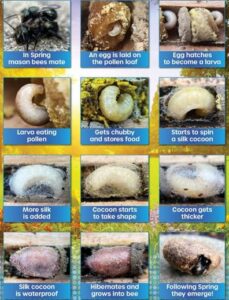
Mason bees are one of Mother Nature’s most productive and efficient pollinators, visiting over 2,000 blossoms daily. Their distinctive “belly-flopping” technique enables the females to gather loose pollen on the little hairs on their body, collectively called the “scopa,” resulting in an impressive 95 percent pollination rate compared with their honeybee cousins’ 5 percent rate.
Unlike honeybees or bumblebees, mason bee species are solitary; every female is a queen. Each finds a nest, lays all her own eggs, and gathers her own food. Mason bees earned their name because of their adept nest-building skills, using mud or other materials resembling “masonry” to create a place to lay their eggs. These gentle bees live and work independently, without producing honey or residing in hives. Their self-sufficiency makes them non-aggressive and easy to care for. Because of this docile demeanor and their efficient pollination skills, mason bees are fast becoming the new bee to host in your backyard.
Watch “Life Cycle of a Mason Bee & How You Can Make an Impact” — a two-year journey using a macro video lens. BEE AMAZED!

Where Do Mason Bees Live?
Mason bee mandibles aren’t strong enough to chew wood, so these bees rely on preexisting nesting holes. In nature, this could include insect holes, hollow stems, woodpecker holes, and other cracks and crevices. A growing number of gardeners are installing bee hotels in their yards to attract and aid these sweet little bees. However, these well-intentioned individuals often overlook the hotels’ proper maintenance and care, which endangers the bees’ health by inviting predators and parasites.
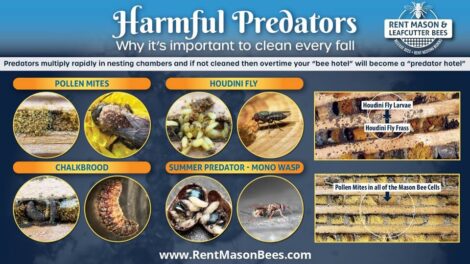
Researchers and industry leaders have observed a rise in predators and parasites that endanger mason bee populations. In nature, mason bees find crevices that are camouflaged and harder for predators to find. But a bee hotel? It’s like hanging up a neon sign flashing “VACANCY” and giving predators an invitation to enter. Failing to address this issue could result in bee hotels becoming infested by these predators, endangering mason bee populations.
Entomologist Abigail Lehner, from University of California, Davis, in the Williams Bee Lab, has observed an increase in invasive parasites. She says, “Houdini flies and pollen mites are prevalent parasites we encounter in mason bee hotels. The only way to reduce the risk is to perform an annual cleaning and sterilization of the cocoons and bee houses.” She emphasizes, “The traditional method of using logs with holes drilled in them for nesting material is no longer suitable, and a change is necessary to care for mason bees properly.”
So, if you hope to host mason bees in your yard, here are steps you can take to provide a healthy habitat.
Proper Care for Mason Bees: 4 Steps for Fresh Nests All Year
- Use nesting material that can be opened. Avoid bamboo or drilled logs, which encourage predators. Instead, opt for materials that can be easily opened and cleaned, such as wood stacking trays or cardboard tubes that can be unraveled.
- Don’t leave nesting material out year-round. Mason bees have a short life span of 6 to 8 weeks, requiring the removal of nesting material at the end of spring to prevent predator infiltration. Store the nests in a garage or shed to get them out of your garden and away from summer predators. In summer storage, the larvae inside will spin silk cocoons. Then, in fall, once those cocoons are formed, you’ll open up the nesting material and harvest and clean.
- Clean in fall and eliminate predators. Fall maintenance is critical. See ”6 Steps for Fall Cleanup” below.
- Provide fresh, clean nesting material each spring. Chalkbrood and pollen mites can linger from the previous season and pose a threat to new generations.

Proper Care for Mason Bees: 6 Steps for Fall Cleanup
For a step-by-step video on how to harvest and clean, visit the Rent Mason Bees website.
- Remove cocoons gently from nesting material to eliminate predators.
- Wash cocoons. Mason bee cocoons are waterproof and need to be washed in a mild bleach solution to remove pollen mites and chalkbrood.
- Dry cocoons overnight so they don’t mold in hibernation.
- Candle cocoons. Use a flashlight to pick out any non-viable cocoons that are amber or see-through.
- Sterilize nesting material. If you use stacking trays, use flame to burn any remaining pollen mites or chalkbrood. Replace all tubes with new ones the following spring.
- Store in winter hibernation in a humidity-controlled refrigerator.
The Convenience of Rent Mason Bees
While some bee enthusiasts find fulfillment in the continuous care and cleaning of mason bees throughout the year, others may opt for a more hands-off approach. For those interested in supporting solitary bee populations and enhancing pollination in their yard without the responsibility of cleaning and storing mason bee cocoons during winter, Rent Mason Bees provides a convenient program. In this program, you can release bees, rent nesting blocks, and they will provide you with everything you need to host mason bees and handle all the cleaning and maintenance for you.
Create a Pollinator Garden
Mason bees are spring pollinators and emerge from their cocoons when daytime temperatures reach 55 degrees Fahrenheit, around the same time you start to see dandelions bloom, which is why they’re an important first food for spring pollinators. By planting spring-blooming trees and flowers, you can support mason bees and other early pollinators. Discover the right plants to cultivate in your yard to bolster pollinator populations by exploring Pollinator Partnership’s beautiful Garden Cards and EcoRegional Guides tailored to your area, providing insights into what to plant to support pollinators. By establishing a habitat conducive to pollinators, you’ll contribute to not only their well-being, but also the overall health of the ecosystem.
Thyra McKelvie runs the pollination program at Rent Mason Bees to help gardeners host solitary bees. Her passion is to educate and teach more people about solitary bees and the importance of taking care of all our pollinators.





