

Learn how to process wool by following the satisfying process of turning wool into finished products.
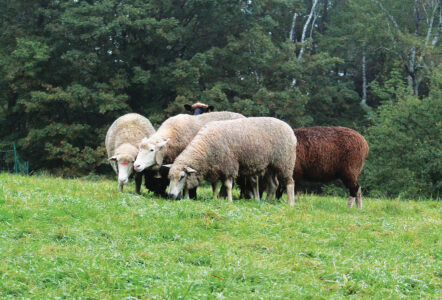
Today, New Hampshire and Vermont are best known for skiing and dairy cattle, but that wasn’t always the case. At one time, the fields that are now full of cattle were populated by sheep. Those thousands of sheep provided tons of wool for an enormous textile industry. For the most part, the sheep are gone, but the mills, now vacant, remain.
Historically, wool was the material of choice for clothing for people who made their living outdoors. Loggers and farmers would’ve been remiss without wool socks, pants, and shirts. With the arrival of synthetic fibers, wool took a back seat – but it never went away. As people seek out more sustainable choices, wool is making a comeback.
Why the Resurgence?
In recent years, there’s been a resurgence not only in the purchase of wool clothing, but also in knitting, crocheting, and even spinning wool for personal use. I credit this phenomenon to people’s desire to step away from the fast-paced world and the use of synthetic materials, i.e., plastics. People want a better way of life.

I’ll describe the steps taken to get from sheep to yarn. A great deal of work goes into making it all happen – from shearing the sheep, to cleaning the fleece, to spinning the yarn, and, finally, to making the item. Many hands touch the wool along the way. The first of those hands, besides those of the farmer, are the shearer’s, and that’s where we begin the journey.
The Role of the Shearer
Before fleece can become yarn, it must be sheared from the sheep; think a big haircut. Looking at the many online videos about sheep shearing, you’d think it’s an easy job. Believe me, it isn’t. It takes many years for someone to learn the skills needed to do the job properly. I spoke to Al Meissner, a local sheep shearer here in New Hampshire, to learn what his job entails.
Meissner’s been shearing sheep for about 10 years. He learned his trade by apprenticing in Australia before refining his craft in Wyoming and Montana and finally coming home to New Hampshire. According to Meissner, “There’s a worldwide shortage of trained shearers. The demand is growing, but the [number of] highly skilled shearers isn’t.”
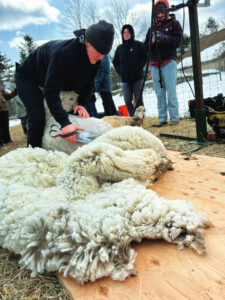
We agreed that the art of shearing is, in some cases, like the business of horse farriers. Both are crafts that are highly skilled and take a long time to perfect, but most people aren’t willing to put in the time it takes to learn to do it properly.
Sheep shearing falls into two categories: shearing that’s done on large commercial farms, and shearing that happens on small farms. Meissner does small-farm shearing, as that’s the type of farm common here in the Northeast. These flocks tend to consist of 100 animals or fewer. On these smaller farms, shearing is usually done only in spring. Sheep with longer fleece may be shorn twice a year.
Meissner says, “Good shearers need to have confidence in their ability, keep the animal comfortable, and do the job with as little stress to the animal and the owner as possible. The goal is to remove the fleece in one piece, which makes it easier for the wool handler. Sometimes that isn’t possible, mainly due to the breed of sheep and how cooperative it is. Sheep with finer wool are easier to shear than those with coarse wool.”
Meissner’s advice to sheep owners: If you find a good shearer you’re comfortable with, stick with them.
Back to the Shepherd
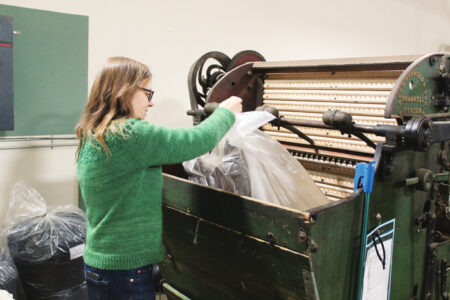
Once the shearing’s done, it’s time for the sheep owner to prepare the fleece for delivery to the processor. The first step is to skirt the fleece. Skirting is a process to remove debris from the wool and divide it according to quality. It’s usually a quick procedure, but more time may be given to specialty wool. Because wool processors charge by raw weight, it’s important to remove as much of the debris as possible.
Once the fleece has been skirted, it’s bagged and sent to the processor.
What Happens During Commercial Processing?
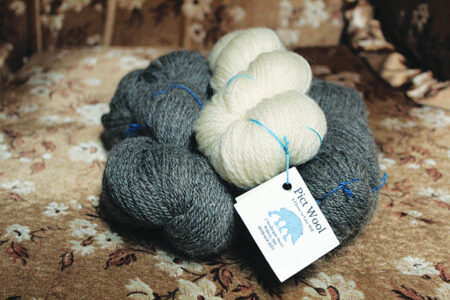
To learn more about commercial processing, I paid a visit to Pict Wool, which is located in Wilton, New Hampshire. There, I met up with Bel and Peter Vassar. In a few short years, they’ve turned a passion for wool into a fully operational wool-processing facility. They’ll process your wool and give it back to you, or they’ll turn that wool into finished yarn. It’s your choice.
I was surprised to see the steps required to turn the raw fleece into usable yarn. When raw fleece is brought in, it first goes to the inspection table, where it’s looked over and any remaining debris is picked out and discarded.
- Washing. The processor washes the fleece in hot (140 degrees F) water to clean it and remove the lanolin, leftover debris, and suint (sweat).
Processors charge by raw weight, and much of that weight is from the waxy lanolin that’s naturally contained in the wool. Generally speaking, the finer the wool, the more lanolin there’ll be. Once the wool is washed, the end product is anywhere from 50 to 75 percent lighter than when it was brought in.
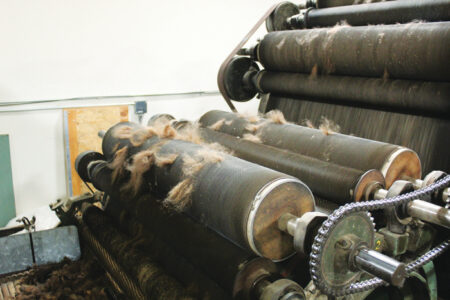
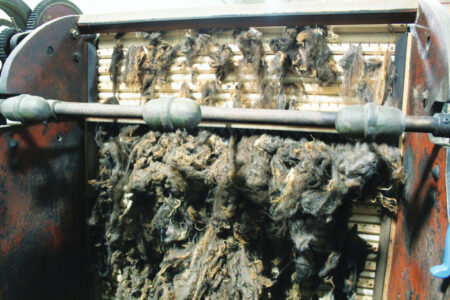
The washed wool is laid on racks to air-dry, and, once dry, it’s bagged until it’s ready for the next step, which depends on how many orders are ahead of it. - Carding. Most people think of carding as a manual process – and it still is for some hand-spinners. Here at Pict Wool, using machinery from the age of woolen mills, the process is strictly mechanical. The dry wool is placed in a hopper, where it travels through a series of combs that pull the wool apart. At the end, the loose wool fibers are put through a coiler, which makes the wool workable for the next process, combing. At this point, hand-spinners take the wool back and finish the yarn-making process on their own.
![]()
- Combing. With combing, the strands of wool are put through another ancient machine that combs it, removing any remaining debris while at the same time pulling the wool and aligning the fibers. This must be done, perhaps a few times, until the wool is the right thickness and condition. The thickness of the strands is entirely up to the customer. Some wool is easier to work with than others, but the process is still the same.
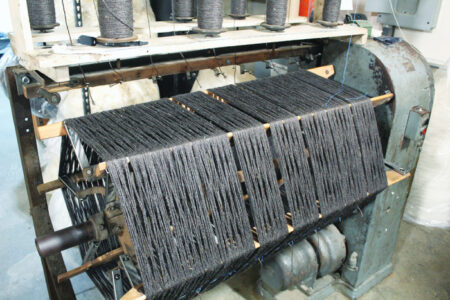
- Spinning. This last step determines the thickness – or “ply” – of the end product. In its basic form, spinning is the twisting of wool fibers. The single-ply is basically a thickness of twine. The larger the ply, the more of this fiber is added. For example, a 2-ply is two spools of single-ply twisted together. The thicker the yarn, the more thread is added.
The yarn is then spun one more time onto a yarn-winder called a “weasel” (as in “Pop Goes the Weasel”), which is set to a specific length. When that length is met, the product is called a “hank.” Once the hank is twisted, it’s called a “skein.”
What About Hand-Spinning?
Long before machines processed wool, fleece was made into a usable product by hand. To find out more about this art – and it truly is a skilled art – I met up with Patty Williams of Aker Fiber Farm in Enfield, New Hampshire. Aker Fiber Farm raises Corriedale sheep for wool and grows flax, turning them into a variety of wool products and fibers for linen.
Williams explained to me that at one time, after machines ruled the world, hand-spun wool products and linen were considered “peasant” products and thus not worth as much as machine-produced products. My, have things changed. With growing attention on getting back to traditional ways and increasing interest in knitting, crocheting, and weaving, hand-spun products are highly sought after. Even the interest in learning how it’s done is on the rise.
- Skirting and washing. As with machine processing, after shearing, the shepherd must skirt the fleece, removing the undesirable bits as much as possible. From there, the fleece is washed to remove the lanolin and any other bits of stuff. Once washed, it’s air-dried. Then comes the carding.
- How to card raw wool. Unlike at Pict Wool, the fleece is hand-carded. For me to get the full experience, Williams gave me the stiff wire paddles and had me start carding the wool. If you’ve never done this, let me tell you, it’s a good workout. What I learned is that it’s not about strength, it’s about technique. Of course, I tried to muscle everything and got nowhere fast. Once I figured out that I needed to let the carding paddles do the work, everything went fine. After that was done, it was time to spin.
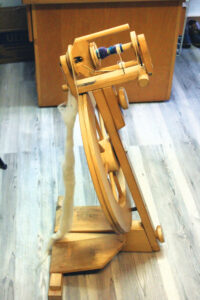
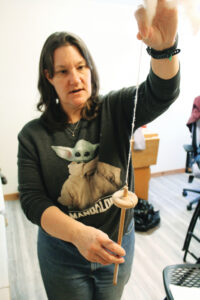
- Choose your spinner. For this task, with some instruction (actually a great deal of instruction), I began to spin the wool fibers using a drop spinner. Basically, this tool is a weight attached to a stick. Spinning the stick clockwise with one hand, you gently pull the fibers with the thumb and the forefinger of your other hand. As you work, you roll the “yarn” onto the stick beneath the weight. The trick is to keep the fiber tight but not too tight, and work more fiber onto the strand – all while spinning the stick. It takes a little getting used to, and it’d be great to have two extra hands, but eventually I got the hang of it. I’m sure I looked like an elephant trying to tap dance. From the drop spinner, we moved to the spinning wheel. This was a big step up and made the yarn-making process much more efficient.
After a while, I left with much appreciation for those who came before me and those who’ve revived the tradition. Now, with yarn in hand, I move to the next step: the finished product.
Knitting It All Together
I don’t knit or crochet. For this part, I turned to my friend Linda Pilla. Pilla, director of Rodgers Memorial Library in Hudson, New Hampshire, and an expert on Irish- and Scottish-inspired sweaters, often spends her time helping others perfect their craft.
My first question for Linda was “Why do you use wool, as opposed to the synthetic yarns on the market?”
“Knitting with wool is enjoyable,” she said. “I like to think about the animals and where the wool comes from, whether it’s alpaca wool from Bolivia or sheep wool from a local farm. It’s a good feeling that the product I produce from the wool, if properly cared for, will last forever, or at least for the rest of my life.”
I then asked, “Of all the different types of wool out there, which one do you prefer to work with?”
“I prefer Icelandic wool for a few reasons,” she said. “First, it’s lightweight and warm. Second, it’s readily available and comes in many colors.”
Switching from Synthetics to Wool
There you have it: from sheep to sweater (or hats, mittens, etc.). For years, wool was the fabric of choice for outdoorspeople. Though synthetic fabrics have taken center stage, the positive news is that people are once again turning their focus to wool. This is good for the environment, good for the local economy, and good for you. If you can’t make your own, search for locally made wool products. Everyone will benefit.
Settle in for some kitting with this pattern for a cowl.
Dana Benner has been writing about all aspects of the outdoors, the environment, and sustainability for 35 years. He also lectures and hosts programs on HCTV in Hudson, New Hampshire.
Originally published in the October/November 2025 issue of MOTHER EARTH NEWS and regularly vetted for accuracy.





