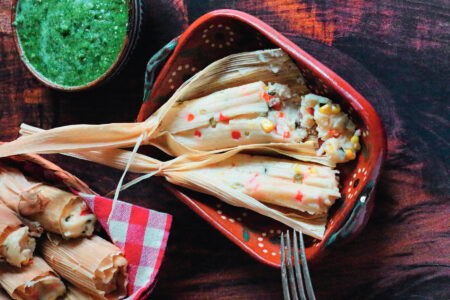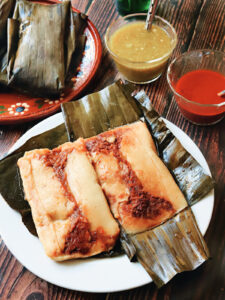
Create this pork tamale recipe with authentic Mexican flavors and wrap them in banana leaves to add a distinct flavor, color, and aroma.
I grew up eating these tamales from Veracruz, where my mother and grandmother are from, but you can also find them in parts of Tamaulipas, San Luis Potosí, and Puebla.
In Mexico, the two most common wrappings for tamales are corn husks and banana leaves. Tamales wrapped in banana leaves are more popular in the south and on the two coasts, regions where banana leaves are plentiful. It’s easier to wrap tamales in banana leaves than in corn husks, but the really special part of using banana leaves is the distinct flavor, color, and aroma they add to the dough.
Ingredients
- Pork Filling: 2 pounds pork shoulder, cut into 1-1/2-inch cubes
- 1 bay leaf
- 1 small white onion, quartered
- 1 clove garlic
- Adobo Sauce: 3 ancho peppers, seeds and veins removed
- 3 guajillo peppers, seeds and veins removed
- 1 morita or chipotle pepper (optional)
- 1 ‘Roma’ or plum tomato
- 1/4 white onion, thickly sliced
- 2 cloves garlic, unpeeled
- 1/2 teaspoon black peppercorns
- 1 tablespoon masa harina
- Salt, to taste
Dough
- 1-3/4 cups lard
- 1 teaspoon salt
- 4 cups masa harina for tortillas
- Leftover pork broth
- 4 large banana leaves
Directions
- Make the Pork: Place the meat, bay leaf, onion, and garlic clove in a large pot, and cover everything with water. Bring to a boil over medium-high heat.
- Once boiling, reduce the heat to low and let simmer for about 30 minutes, or until the meat is cooked. (The meat doesn’t need to be fork-tender; it’ll keep cooking when you steam the tamales.)
- Place the meat in a large bowl, reserving the cooking broth (which will be used to make the dough).
- Make the Adobo Sauce: While the pork is cooking, heat a comal (or griddle or cast-iron skillet) over low heat. Once hot, lightly toast the peppers. Gently press the peppers with a wooden spatula to make sure they toast evenly. After a few seconds, as soon as the skin of the peppers starts forming some blisters, remove them from the comal (do not let them burn).
- Place the toasted peppers in a large bowl and cover them with hot water. Let them soak for 20 minutes or until soft. (You can place a heavy plate on top of the peppers to keep them submerged in the water.)
- On the same comal, toast the tomato, onion slices, and 2 unpeeled garlic cloves, rotating them to achieve an even roasting. Remove the garlic and onion promptly because they’ll take less time to toast. The tomato will take about 8 minutes. After toasting the vegetables, toast the peppercorns for a few seconds, or until they start releasing their aroma.
- Remove from the heat and let cool.
- Drain the soaked peppers, reserving 1 cup of the soaking water.
- Place the peppers in a blender along with the roasted tomato, onion, garlic (peel before adding to the blender), peppercorns, 1/2 cup of the peppers’ soaking water, and 1 tablespoon masa harina. Process until you have a fine, thick sauce.
- Season the sauce with salt, add it to the bowl with the meat, and mix well. If the sauce is too dry, add a little bit more of the pepper water.
- Make the Dough: Place the lard and salt in a large bowl. Beat the lard until it’s light and creamy.
- Slowly incorporate the 4 cups masa harina and 3-1/2 cups of the reserved pork broth, a little at a time, until the dough is well-mixed, smooth, and homogenous, with a creamy and spreadable consistency.
- Taste the dough and add more salt if needed. (Keep in mind that the dough will lose some of its saltiness during the steaming process.)
- Prep the Leaves: Cut the banana leaves into 10-to-12-inch squares.
- Briefly pass the leaves over the heat (or flame) of your stovetop, making sure to pass the whole leaf over the heat. The leaf will become soft and pliable, and the surface will become glossy.
- Rinse the leaf sections with warm water and dry before assembling tamales.
- Assemble the Tamales: Place 1/4 cup of the dough onto the center of a banana leaf piece. Spread the dough around to form a rough circle 4-1/2 to 5 inches in diameter. This layer of dough should be about 1/4 inch thick.
- Top the dough with 1 or 2 pieces of the meat and some of the adobo sauce.
- Fold both sides of the leaf inward toward the center, then fold the bottom and top ends of the leaf toward the center.
- Place the wrapped tamale on a tray while you finish wrapping the remaining 11 tamales.
- Steam the Tamales: Place a steamer rack inside a large stockpot. Add enough warm water up to the level of the steamer rack, then line the rack with 1 or 2 pieces of banana leaves.
- Place the tamales horizontally in the pot, layering all of them on top of each other in a staggered manner (like bricks on a wall).
- Cover the tamales with more banana leaf pieces, then cover the pot with the lid. (You can also cover the banana leaves with a layer of foil to form a better seal.)
- Steam the tamales for 1 hour and 15 minutes over medium-high heat. During the steaming, check the pot to see if it has enough water (be careful when removing the lid), adding more if needed (see “Notas,” below).
- To check if the tamales are ready, remove one from the pot using kitchen tongs and let it sit on a plate for 5 minutes. This will give the dough a chance to solidify after coming out of the steaming pot.
- After the waiting time, open the tamale. If the banana leaf separates easily from the dough when you open it, then the tamales are ready; if not, then return the tamale to the pot and continue cooking for 15 more minutes.
- Serve while still hot.
This recipe has a sauce made with dried peppers, but in other places, people might use a tomato-based sauce, a mole, or an achiote sauce.
Notas
- If you need to add more water to the pot when steaming the tamales, pour it as close to the side of the pot as possible, avoiding the tamales.
- This recipe only yields 12 tamales, so double or triple the recipe as needed.
- You can omit the morita pepper if you’re sensitive to spiciness or add more if you like it spicy.
Try our pickled red onions, jalapenos, and carrots on our vegetarian tamales recipe.
Mely Martínez is a former schoolteacher, a home cook, and a food blogger. She moved to the United States about 10 years ago, after living in Mexico her whole life. These recipes are excerpted from Mexico in Your Kitchen: Favorite Mexican Recipes That Celebrate Family, Community, Culture, and Tradition.
Originally published in the December 2025/January 2026 issue of MOTHER EARTH NEWS magazine and regularly vetted for accuracy.