

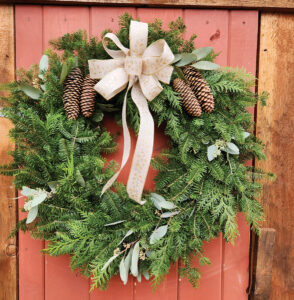
Learn how to make a pine wreath and personalize it with ribbons, dried flowers, or pine cones to preserve the natural beauty of your changing landscapes.
The smell of pine transports me back to my childhood, to a neighbor’s farm where we’d gather in an old and otherwise abandoned house for a workshop during wreath season. That place was magical to me as a child; it was filled with old artifacts of those who’d come before, objects that had been left to gather dust, save for the fingerprints of me and my friends on the cool fall mornings when Christmas music filled the air and hot chocolate filled our bellies.
Around the age of 5, my sister and I, along with our two friends, were taught how to make wreaths by our moms. Our mothers were crafty and had entrepreneurial spirits, and they saw this annual tradition as a way to earn extra money before the holidays while catching up with each other amid their daily farm chores. Our first wreaths were a bit unruly: Some were spindly, most were asymmetrical, but all were made with enthusiasm and love. In those early years, our wreaths were gifted to family, and over time, we honed our craft.
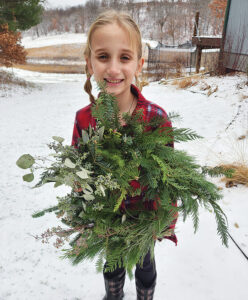
I’m now in my early 40s, and I’ve been making wreaths every year since. In fact, all of us still do, and we’ve passed this skill on to our own kids. Custom wreath orders paid my way through college, and, as an adult, I’ve used them as a gateway to meet other creative souls in the different communities where I’ve lived. The invitation to gather, whether around my kitchen table or in a formal workshop, and teach the process of wreath-making has been a ritual that has brought me so much joy.
Bringing Nature Indoors
I’d like to invite you to experiment with this process and tradition too. Let the landscape that surrounds you be your inspiration when choosing which materials you’ll incorporate into your wreath. You can create a wreath for any season simply by substituting the natural elements. For a winter-style wreath, I primarily use white pine (Pinus strobus), red pine (P. resinosa), and balsam fir (Abies balsamea) as my evergreens; in recent years, I’ve been infusing more of the whimsical spirit of our prairie into my wreaths.
In 2014, we restored a fallow field to native prairie. We wanted to add a greater diversity of species and habitat to our farm, which is otherwise mostly wooded with a few pastures. Historic air photos of the area show a more open landscape in the 1930s and roadside remnants of tallgrass prairie. We purchased a seed mix and collected additional species by hand. In the years since, it’s been a sheer delight to watch the prairie transform throughout the seasons, from the bloom of forbs in various colors of the rainbow in early to late summer to swaying amber and coppery grasses toward fall.
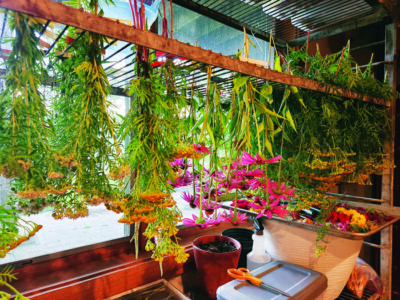
My collection of wreath materials begins months before I actually create, and it’s a process I like to do myself, as it allows me to visit and connect with the prairie and woods. While snow still blankets the ground in late February, I’ll trek out to the prairie in search of the stiff stalks of round-headed bush clover (Lespedeza capitata) and the umbrella-like architecture of white wild indigo (Baptisia alba), whose black seedpods make music in the slightest wind. When July comes, I’ll revisit the prairie and harvest purple coneflower (Echinacea purpurea) and yellow coneflower (Ratibida pinnata) and hang them upside-down to dry or cover them in a shallow dish with sand. In late summer, just as the seed heads begin to form, I’ll gather switch grass (Panicum virgatum) and yellow prairie grass (Sorghastrum nutans) to dry them with the flowers.
As the calendar flips to November, I’ll wait for a cool spell to make the first of several trips to the woods to gather evergreen branches. I’ll count as I go, since I’ll need 8 to 10 branches for each wreath I plan to make. I’ll look for branches that’ll self-prune soon because of competition from neighboring trees.
Once I’m back at the farm, with my pile of evergreen boughs and dried flower embellishments, the creation begins.
Tools and Materials
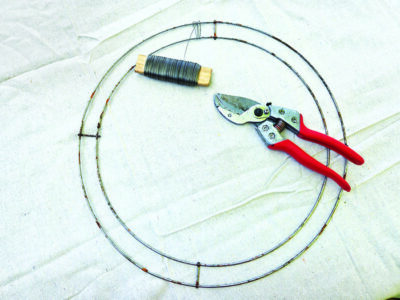
- Hand-held pruner
- Evergreen boughs
- Paddle of 22-gauge wire
- Metal wreath ring, grapevine wreath, or old bicycle ring
- Optional embellishments: locally sourced pine cones; dried prairie flowers; sumac berries; dried millet, sorghum, or broom corn heads; feathers; bows; or ribbons
How to Make a Pine Wreath
A 14-inch wreath frame will make a finished wreath that’s the perfect size for displaying on a door.
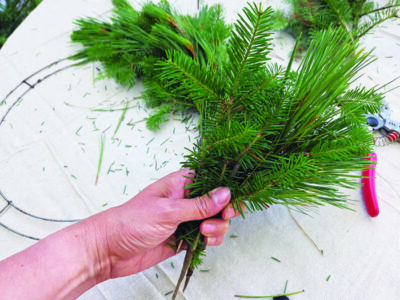
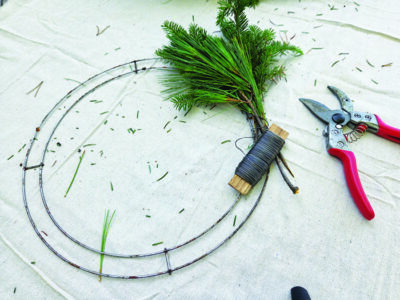
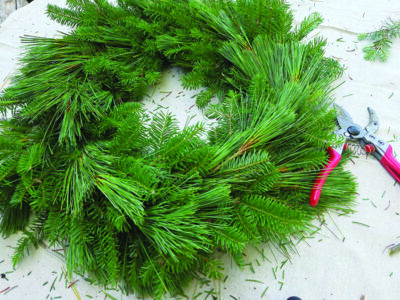
- Snip the boughs into pieces about the size of an open hand, leaving a piece of stem on each piece so you can gather them like a bouquet. Create a bundle of 3 to 4 pieces to adhere to your wreath form, putting the fullest piece on top.
![]()
- Adhere the wire to your wreath form and secure it so it won’t come loose when you pull it.
![]()
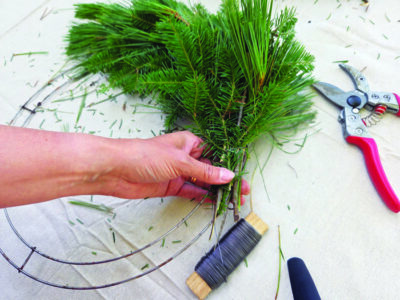
- Lay your first bundle of branches on the top of the form and wrap wire around the collection of stems 4 to 5 times, holding tension on the wire. Wrap the wire around a single piece of stem to keep the wire tight while you select your next bundle. Don’t cut the wire until the last bundle is attached.
![]()
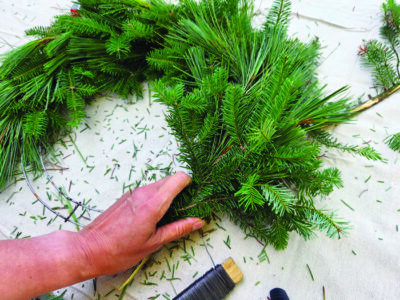
- Place your second bundle such that the widest part of it rests on top of the lowest branches of the first bundle. This will create a slight overlap to cover the stems of the prior bundle. Repeat this step until you’ve worked all the way around the wreath form.
![]()
- If desired, add a ribbon bow to where your first and last bundle meet. There’s often a small gap that can be obscured by the bow.
![]()
- Use wire to attach any additional embellishments, such as pine cones and dried flowers. Alternatively, you can put dried flowers, prairie grasses, or other natural elements on top of each bundle as you construct the wreath so these natural elements show throughout. There’s no right or wrong way to decorate, so let your personality and the natural elements that grow in your area shine through.
Something about working with natural materials to craft a wreath on the darker days of fall helps me move through this seasonal transition with gratitude for the seasons before and hope for what’s to come. Perhaps you’ll be inspired to make a wreath this season too.
Alanna Koshollek was born and raised in Wisconsin and has built her life around conservation, sustainability, and creativity. She works as an independent contractor, supporting conservation and sustainable-agriculture nonprofits that serve private landowners and stewards across the Upper Midwest. At home, she and her husband are raising their daughter on a 60-acre farm in rural Jackson County, Wisconsin, where they manage grass-fed beef, chickens, and abundant gardens.
Originally published in the December 2025/January 2026 issue of MOTHER EARTH NEWS magazine and regularly vetted for accuracy.





