

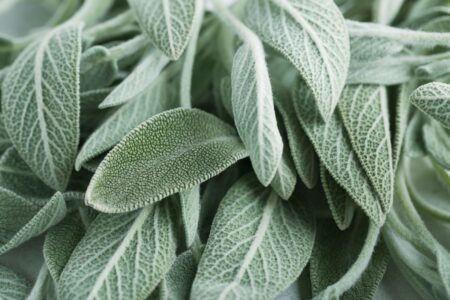
Sage is an herb of ancient repute, long valued as a culinary and medicinal plant. The Romans called it herba sacra or “sacred herb. Both the common name and botanical name, Salvia officinalis, originate in the Latin salvare, meaning “to save” – perhaps referring to its ability to save health. Sage, a native of the Mediterranean region and cultivated worldwide, is a familiar herb, with a fresh, warm-spicy, herbaceous aroma that many of us associate with the Thanksgiving holiday.
It has a stimulating, heating, and drying energy, and in the herbal medicinal realm, is a well-known cold germ and flu fighter, having particularly potent antimicrobial, respiratory antiseptic, antioxidant, anti-inflammatory, astringent, mucolytic (mucous thinning), antispasmodic, and vulnerary (tissue healing) properties.
With summer’s warmth waning and the fall/winter season rapidly approaching, it’s prudent to start thinking about stocking your natural medicine cabinet with beneficial herbs that will arm you in your preemptive strike against the onslaught of cold and flu “bugs.” Sage is definitely one of those herbs.
The recipe below is of my favorite culinary sage medicinal formulations and a bottle of this lovely infused oil is always in my arsenal of herbal remedies against colds and flu. My suggestion is that you make a batch now and start using it as soon as the fall weather hits. As the saying goes, “An ounce of prevention, is worth a pound of cure.” So true!
Preparation Note: If you have plenty of sage growing in your garden right now, and want to use the fresh leaves in the making of this recipe, you will see that the ingredient list calls for either dried sage or “freshly wilted sage leaves.” Allow me to relate what “freshly wilted” means and explain the procedure:
Wilting (Partially Drying) Herbs
Wilting is the drooping and withering of the leaves or other parts of a plant – it is the first stage of drying. When you make an infused oil from fresh herbs, you need to wilt the herbs first; the process removes sufficient moisture from the plant material to inhibit mold and bacterial growth without affecting the healing properties.
The process of wilting is simple, and I’ll use fresh sage leaves in this example. To make 3 cups of freshly wilted sage leaves, pick approximately double that amount to allow for shrinkage. Some delicate plant parts, such as rose petals and calendula petals, shrink considerably, while lavender buds and chamomile flowers don’t as much. Thick leaves such as rosemary and sage will shrink a moderate amount, while more tender leaves, such as lemon balm and peppermint can shrink significantly.
You’ll learn through trial and error how much fresh material to pick – it’s not an exact science.
To begin, simply snip the sage leaves from the stems after the morning dew has dried, but before the sun gets too warm; or, harvest them on a cool, dry evening. Spread the leaves on a clean screen, pillowcase, or length of lint-free cloth (a long strip of paper towels will do as well) in a warm, still location that is mostly shady and is protected from wafting animal dander, dust, and flies. I usually wilt my herbs on a table in my study or in the backseat of my car – away from my curious cats.
Allow the leaves to wilt for 24 to 48 hours, depending on temperature and humidity. If humidity is very high, add another 24 hours. You should notice a distinct change in texture, from firm and fresh to limp and soft, or even a bit on the leathery, resinous side, especially if the temperature is over 90 degrees Fahrenheit and humidity quite low.
The size of each leaf will diminish as the water evaporates out of the plant material. The amount of shrinkage depends on the temperature and level of humidity; the warmer and drier, the greater the reduction in herb size.
Keep this in mind: Unlike dried herbs, which can be stored in airtight containers at room temperature for up to 1 year, wilted herbs are still relatively fresh and cannot be stored for any length of time. They must be prepared a couple of days prior to when you intend to make a given recipe.
Winter Defense Sage Body Oil Recipe
Traditional healers around the globe have used sage for centuries. With sage growing in your garden, you have an elixir of good health right outside your door. Their soft, gray-green leaves will be at the ready for making this potent, aromatically earthy, warming infused oil.
When massaged into the skin from head to toe on a daily basis, sage-infused oil aids in strengthening the body’s immune system, supporting its defenses against outside invasion of the three main sources of disease: bacteria, viruses, and fungi. The oil conditions the skin, too, keeping it soft, elastic, and healthy.
I can hear you thinking, “If I put sage oil on my skin, won’t I smell like Thanksgiving stuffing?” No worries. The fragrance may be rather potent in the bottle, but it becomes quite subtle upon application.
Note: I prefer to use the stovetop method of extraction for this formula, as I feel that the resinous sage leaves release their best medicinal properties and strongest aroma when processed in this manner.
Ingredients
- 1-1/2 cup dried or 3 cups freshly wilted sage leaves
- 3 cups extra-virgin olive, soybean, or almond base oil (use almond or soybean oil if you want a lighter fragrance and texture)
- 2,000 IU vitamin E oil
Equipment: 2-quart saucepan or double boiler, stirring utensil, candy or yogurt thermometer, strainer, fine filter, funnel, plastic or glass storage containers
Prep time: 4 hours
Yield: Approximately 2 ½ cups
Directions
- If you’re using freshly wilted sage leaves, first cut or tear the slightly leathery leaves into small pieces to expose more surface area to the oil.
- Combine the leaves and base oil in a 2-quart saucepan or double boiler and stir thoroughly to blend. The mixture should look like a thick, pale green herbal soup.
- Bring the mixture to just shy of a simmer, between 125 and 135 degrees Fahrenheit.
- Do not let the oil actually simmer — it will degrade the quality of your infused oil. Do not put the lid on the pot.
- Allow the herb to macerate in the oil over low heat for 4 hours. Check the temperature every 30 minutes or so with a thermometer and adjust the heat accordingly. If you’re using a double boiler, add more water to the bottom pot as necessary, so it doesn’t dry out.
- Stir the infusing mixture at least every 30 minutes or so, as the herb bits tend to settle to the bottom. After 4 hours, remove the pan from the heat and allow to cool for 15 minutes.
- While the oil is still warm, carefully strain it through a fine-mesh strainer lined with a fine filter such as muslin — or, preferably, a paper coffee filter — then strain again if necessary to remove all debris. Squeeze the herbs to extract as much of the precious oil as possible. Discard the marc.
- Add the vitamin E oil and stir to blend. The resulting infused oil blend will be a rich medium to dark green in color, depending on which base oil you chose. Pour the finished oil into storage containers, then cap, label, and
- Store in a dark cabinet.
Storage: Store at room temperature, away from heat and light; use within 1 year
Application: Once daily
Application Instructions: For maximum benefit, massage this infused oil into slightly damp, warm skin — fresh from the shower or bath. Apply daily for at least a month prior to cold and flu season, and continue to use it throughout the winter.
Bonus Sage oil makes a terrific diaper rash preventive and is wonderful added to salves and balms to help heal minor skin afflictions, respiratory infections, and dry, rough skin on the feet, elbows, and knees.
Find this and more recipes for smoothies, green drinks, frappes, shakes, nut milks, and other luscious, health-boosting, raw food beverages in my latest book, Hands-On Healing Remedies: 150 Recipes for Herbal Balms, Salves, Oils, Liniments & Other Topical Therapies (Storey Publishing, c2012). I’ve also written many other books, including my best-selling, Organic Body Care Recipes (Storey Publishing, c2007), Hands-On Healing Remedies(Storey Publishing, c2012), and Raw Energy: 124 Raw Food Recipes for Energy Bars, Smoothies, and Other Snacks to Supercharge Your Body (Storey Publishing, c2009). Please visit my website to learn more about me and what I’m up to these days.
Stephanie Tourles is a licensed holistic aesthetician, certified aromatherapist, and gardener with training in Western and Ayurvedic herbalism. She is the author of ten books — which are available at MOTHER EARTH NEWS Shopping— including Raw Energy in a Glass, Hands-On Healing Remedies, Organic Body Care Recipes, Raw Energy, Naturally Healthy Skin, 365 Ways to Energize Mind, Body & Soul, and Natural Foot Care. She lives in Orland, Maine.
All MOTHER EARTH NEWS community bloggers have agreed to follow our Blogging Best Practices, and they are responsible for the accuracy of their posts. To learn more about the author of this post, click on the byline link at the top of the page.





