

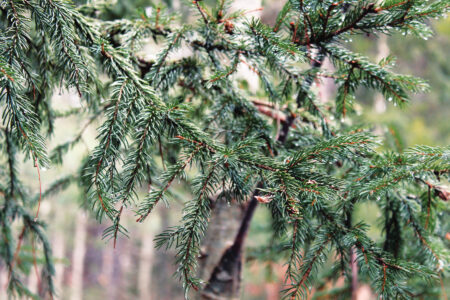
No matter the season, foraging is like a treasure hunt. Sometimes you get the prize, and sometimes you don’t. Winter for me in northern New England is much different than winter in Texas or even Virginia. It can start as early as November and end sometime in April. As I write this piece, I’m experiencing snow measuring in feet, not inches, which makes getting out there more difficult. In normal times, my frost-free season runs only about 100 days, but despite this, foraging is still possible.
What I’ll cover here is recreational foraging for a typical winter in my area – the resources found in the South will be different than what I find here in the North. The environment, air temperature, snow cover, and other factors will dictate when, and if, you can get out and what you’ll find when you get there. When you’re out, take only what you need. Like us, wildlife of all kinds are searching for the same food sources. Leave some for the birds and squirrels. Never eat something unless you’re 100 percent certain of its identification, and don’t rely on AI to identify a plant for you.
Safety First
Please keep safety in mind at all times. Carry a plant identification book with you, as many look-alike plants can be poisonous. Even better, go foraging with an experienced person until you build up your skills. Learning the hard way isn’t pleasant.
Part of being safe also means dressing for the conditions. Dress in layers, and put on gloves and a hat. I like to wear flannel-lined pants and shirts to give me some extra protection. Last, but not least, wear the proper footwear. If you’re cold, it’ll be no fun and also potentially life-threatening.
Forest Finds
In winter, the forests are the first place I go. Usually, there’s less snow cover there compared with other foraging spots, and what I’m searching for is easier to find. The forest provides a host of things, including seeds, nuts, and berries. Here are some trees to look out for.
Beeches. In late winter, finding beechnuts, the seeds of the beech tree (Fagus grandifolia), is difficult, but early in winter, they’re pretty easy to spot. I often collect loads of them while hunting turkeys in late fall (beech groves are perfect places to find big turkeys). If there’s a midwinter thaw, you can still find some beechnuts that the turkeys missed. These nuts are small, so it takes a large amount to fill your larder, although, truth be known, I never really fill it. Still, beechnuts are a great addition to your pantry.
Oaks. Find a grove of oaks (Quercus spp.), and you’re likely to find some acorns that survived through the fall rush of deer, bear, grouse, and turkeys. You may need to dig through some snow, but you’ll find some acorns if you stick with it. A folding shovel is good to have on hand.
Acorns are high in tannic acid, which you’ll need to leach out, but once that’s done, they’ll be safe to eat or use in cooking. Properly leached acorns can be eaten as-is or used in different recipes. Acorn flour can be used to thicken many dishes.
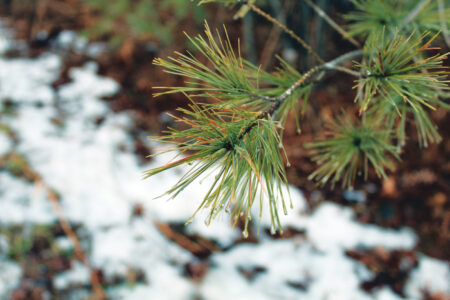
Pines. Pine nuts are popular with the people of the West and South, where the pine cones tend to be huge, but here in the East, we also have pines (Pinus spp.) that produce pine cones and, thus, pine nuts. Pine nuts are simply the seeds of the pine, which are housed in and then released from the cone. Pine cones and the seeds they contain are cherished by squirrels and birds but often overlooked by people.

Where I live, we have white pine (P. strobus), red pine (P. resinosa), pitch pine (P. rigida), and a host of cultivated pines, and all of them produce pine cones. While these pine cones tend to be smaller, the nuts are full of fat and other important nutrients.
Pine nuts aren’t the only things that can be harvested from pines. Green pine needles can be harvested and used to make teas. These teas, which are high in vitamin C, can be helpful when you’re fighting a cold or sore throat. The needles of some spruce trees can be used for the same purpose. Keep in mind that not all “pines” are the same. Lodgepole (P. contorta) and ponderosa pines (P. ponderosa) are toxic, as is the American yew (Taxus canadensis) and the Norfolk Island pine (Araucaria heterophylla). Before you ingest anything, properly identify it.
Another thing that can be harvested is the sap, or “pitch,” of the pine. This sticky substance can be used as a glue, but I use it as a covering for burns and open wounds.
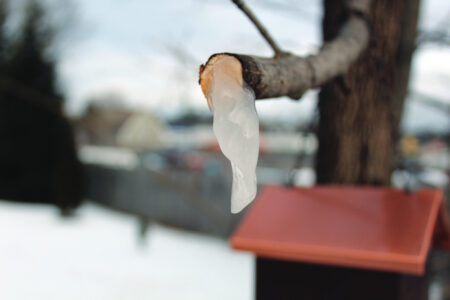
Sap-producing trees. Late winter is my favorite time of the year, as this is the time to tap the trees for their sweet sap. Though maples (Acer spp.) are the most-known, some Indigenous people have traditionally harvested the sap of other trees, including birch (Betula spp.), ash (Fraxinus spp.), and elm (Ulmus spp.). I no longer tap elm trees or white ash (F. americana), on account of Dutch elm disease and ash borer beetles, respectively, so as to not stress the remaining trees.
Willows. There are many species of willow (Salix spp.), and they grow everywhere. The inner bark has many medicinal properties, and the catkins (seedpods) are edible.
On the Forest Floor
The forest floor is where you’ll find a few of my winter favorites.
Teaberries. As a kid walking through the late winter woods in New Hampshire, I’d often find “wintergreen” poking up through the snow. What we called “wintergreen” is also known as the teaberry plant (Gaultheria procumbens). Finding the red berries would be a real treat, though I was happy, and I still am, with just the leaves, which are edible as well. The berries I’ll use in sauces, while the leaves will make a great addition to teas and drinks (see below for one such tea).
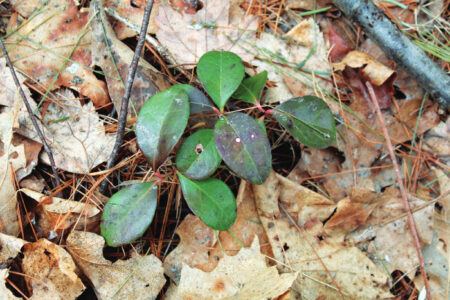
Partridge berries. Like the teaberry, partridge berries (Mitchella repens) are low-growing ground cover. Unlike teaberry, these berries have no distinct flavor but are mildly sweet.
Searching the Fields
In my area, the fields are mostly what’s left from long-abandoned farms. It’s surprising just how much you can find in winter.
Apples and crab apples. Many of the apple and crab apple trees (Malus spp.) you’ll find are holdovers from those farming days. Find an old cellar hole, and you’ll likely spot feral fruit trees. It’s hit-and-miss when it comes to apples, but they’re worth the search. Not all apple trees are the same, though, and some won’t hold their fruit through the winter. Crab apples will hold their fruit clear to spring, unless the birds beat you to them.
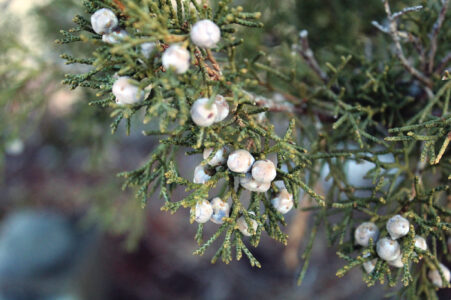
Juniper berries. If you’ve ever tasted gin, then you’re familiar with juniper berries. Juniper berries aren’t actually berries; instead, they’re the cones of the juniper bush (Juniperus communis). Junipers are low-growing conifers that are common in fields bordering forests. Being conifers, junipers will produce cones all year long. Ripe “berries” will be blue, and though small, they can be used in numerous recipes.
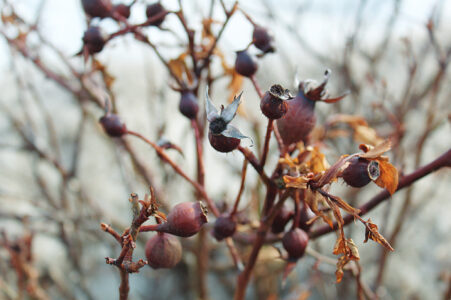
Rose hips. These are a favorite among both humans and birds during winter. The trick is finding wild roses (Rosa spp.) to harvest from. My two favorite places to find them are on abandoned farms and along the coast. If the wildlife hasn’t gotten to them, rose hips will stay on the bush until spring.
Forage with Care
Winter foraging can be fun, as you just never know what you’ll find. Enjoy these wild foods, but if you’re not sure of what you do find, leave it alone. It’s better to be safe than sorry.
Nasaump
For this porridge, use whatever nuts are available. My mother sometimes cooked with acorns, as they were the most plentiful, but she also substituted walnuts and sunflower seeds as needed.
- 1-1/2 cups cornmeal
- 1 cup berries (blueberries, raspberries, strawberries, or a combination of berries)
- 1/2 cup nuts
- Maple syrup, to taste
- Add all of the ingredients to 1 quart of water in a pot and bring to boil.
- Turn heat down to medium, and cook for about 15 minutes, stirring often.
Pine Needle Tea
Pine needle tea was just one way my Abenaki ancestors fought the common cold, and there are many ways to prepare this tea. What follows is my way.
- Handful of pine needles
- Teaberry leaf (optional)
- Honey (optional)
- Identify the pine. White pine is the main one in my area, so there’s no real worry, but in other areas, this may not be so. White pine needles grow in bunches of five.
- Collect the needles. You don’t need much – a handful will do.
- Put the needles in a saucepan and cover with water. Bring to boil.
- Remove from heat, and steep for about 15 minutes.
- Strain the needles from the tea. Here, I may add a teaberry leaf, and if I have a sore throat, a little honey.
Dana Benner has been writing about all aspects of the outdoors, sustainability, and the environment for 35 years, with his work appearing in numerous publications, including Grit, Mother Earth News, Countryside, and Backwoods Survival Guide. He also lectures and hosts programs on HCTV Hudson, New Hampshire.
Originally published as in the December 2025/January 2026 issue of MOTHER EARTH NEWS magazine and regularly vetted for accuracy.





