

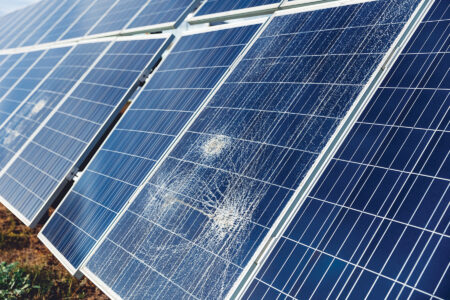
Sooner or later, something worse than bird droppings is bound to hit your solar panels. Read on for solar panel repair tips and learn what you can do to locate similar panels.
Welcome to our series answering reader questions and concerns about how to cut the utility-company cord.
One panel of my ground-mounted solar system shattered (likely because of a rock thrown up by a lawn mower), but the company we contracted with for our system is now out of business. How do I go about getting a replacement panel that works with my system?
-Michael, Washington
When you have glass solar panels sitting out in the open, sooner or later, something worse than bird droppings is bound to hit them! If you find that your installer has gone out of business, it’s not the end of the world – the solution just might not be cheap or easy.
First, let’s talk about one of the primary causes of single-panel failure: micro-cracks. Micro-cracks occur when small stones or hail hit the glass, causing nearly invisible fissures that can grow from natural expansion and contraction, allowing moisture to get in. Higher-quality panels have a protective layer of tempered glass made to handle a 1/2-inch hailstone falling at 50 miles per hour. Your options hinge on your panel’s warranty and your insurance. One of my customers had several panels bashed in by potato-sized hail, an event lasting less than 15 minutes that did $100,000 in damage from micro-cracks! Thankfully, his insurance covered most of the cost for a full replacement, so I recommended he replace all panels and save any salvageable ones for other buildings or sell them. (A couple of years later, he found surplus solar panels identical to the original ones through a bankruptcy sales warehouse, and he used them to augment the older, relocated panels.) Unfortunately, I haven’t seen warranties that cover rock damage, but you can purchase homeowner’s insurance plans that should.
Even though your solar installer went out of business, you’ll be able to find other qualified companies. Smaller installers tend to dedicate their hours to new systems, rather than maintenance, to stay in business. They simply can’t afford to stop to replace a single solar panel, unless you negotiated a strong agreement with them. On the bright side, you don’t need a solar company to replace a few panels; a licensed electrician should be able to do the job.
Your next challenge will be finding a comparable panel. Manufacturers change their models from one year to the next, so you may have issues with fitting newer panels into the same space as the damaged ones. For those purchasing new systems, budgeting for a few spare panels wouldn’t hurt. But when replacing a whole system is unwarranted or not an option, shop online auction sites using the information on the back of your panels. If the panel manufacturer is still in business, you might find a dealer with a few panels stashed in their warehouse.
Whether you’re replacing one solar panel or several, here are some important rules to follow.
Get the same color panels as the originals. There aren’t a lot of choices for residential systems – you probably have either black or blue panels.
Look for similar frames. Some panels are frameless, while others come with frames in a variety of sizes and thicknesses. Some frames are made of aluminum, others of synthetic material. You want clamps to be able to hold down adjoining units securely.
Use replacements with electrical characteristics similar to the originals. Solar panels over the years have gotten bigger in physical size and produce more electricity per module. The new panels should be reasonably close. If your original panels are sized at 150 watts with 60 cells, a 400-watt panel with 72 cells wouldn’t be a good fit. A 60-cell panel rated between 145 and 155 watts should work fine.
Hold on to the data sheet for your particular system in case you need to search for matches. In the worst cases, you may need to replace all panels to get them matched, and this could qualify for an insurance claim.
Hoss Boyd is founder, president, and CEO of TeraVolt Energy and a recognized solar and energy-storage expert. Learn more about TeraVolt Energy at http://TVNRG.com.
Originally published in the August/September 2025 issue of MOTHER EARTH NEWS and regularly vetted for accuracy.





